|
Alice Through the Looking-Glass
A “Family Opera” for small orchestra and singers. Text and music by William Osborne, based on the book of Lewis Carroll
COPYRIGHT WILLIAM OSBORNE, ALL RIGHTS RESERVED Jan. 7, 2020
Table of Contents
1. General Description 2. A video score and orchestral simulation without the vocal parts. 3. The Alice Song Cycle In Enlighs and German 4. Program Notes
1. General Description
A children’s opera for chamber orchestra and singers based on Lewis Carroll's Alice Through the Looking-Glass. (55 minutes.)
Instrumentation: strings, 2 fl., 2 ob., 1 cl., 2 bsn., 1 trpt., 2 horns, strings, 1 perc., 1 harp. (Woodwind doublings: Piccolo, English horn, E-b clarinet, B-b Bass Clarinet, Contrabassoon)
Voices:
Alice, soprano Lewis Carroll, baritone White King, tenor White Queen, soprano Humpty-Dumpty, baritone Tiger-Lily, alto Rose, soprano, Two Daisys, sopranos Tweedledee, baritone Tweedledum, baritone Sheep, tenor Unicorn, tenor White Knight, baritone Royal attendant, tenor
Most of the material for this opera was composed around 1976. Some additional material was added in 1984. It was orchestrated in late 1984 and early 1985, and was premiered in by the Israel Chamber Orchestra in March 1985 in a Hebrew translation. In 2019, William made significant revisions to the work.
In the mid 1970s, William was studying with
George Crumb so the opera bears his influence—the use of
8ths as beat units so that the extra ligatures better illustrate the
music, the long afterglow ending, the emulation of sounds of nature, the
postmodern neo-romanticism, the musical quotations, and the pervasive
sense that there’s something magical about music, that it’s an
incantation to lead us to other worlds. The original concept of
the work was more avant-garde, centered around sound art and a small
ensemble using many special effects. Examples are
here and here.
2. A video score and orchestral simulation.
COPYRIGHT WILLIAM OSBORNE, ALL RIGHTS RESERVED Jan. 7, 2020
A Boat Beneath A Sunny Sky (from the staging of the opera by the Israel Chamber Orchesta in March 1985. Sung in Hebrew.)
3. A Song Cycle Taken from Alice
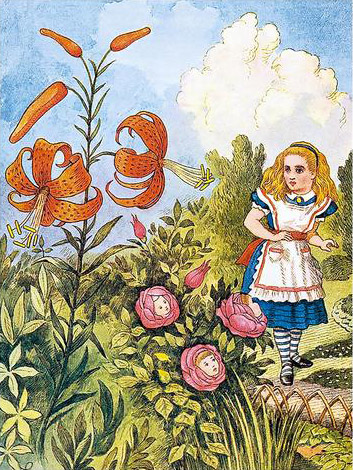
There is also a cycle of six songs for soprano and baritone taken from the opera in both English and German. (Scroll down for the video score of the German version.) The titles of the six songs included in this cycle are below and hyperlinked to where they begin in the video score. Farther down is a performance of the first song, "Kind mit der kalren Stirne du," by Yaron Windmueller and Leonore Hall recordedin 1984.
1. Child of the Pure Unclouded Brow (baritone.) 2. The Jabberwocky (soprano) 3. The Garden of Live Flowers (soprano) 4. In Winter (duo) 5. Little Fishes (baritone) 6. A-Sitting On A Gate (baritone) 7. A Boat Beneath A Sunny Sky (duo)
The German version of the song cycle. (The same German setting could be used for the full orchestral opera.)
1. Kind mit der klaren Stirne du (Bariton) 2. Der Zipferlake (Sopran) 3. Im Garten der sprechenden Blumen (Sopran) 4. Im Winter (duo) 4. Kleine Fische (duo) 5. Hoch droben auf der Pforten (Bariton) 6. Ach, jenes Boot am Uferrain (duo)
Kind mit der klaren Stirne du recorded by Yaron Wind Mueller and Lenonore Hall in 1984.
4. Program Notes
The opera
begins with Lewis Carroll singing the poem that opens his book Alice
Through the Looking-Glass. The verses lovingly commemorate the day he
first extemporized the story for Alice as they drifted
down the Thames in a rowboat--July 4, 1862.
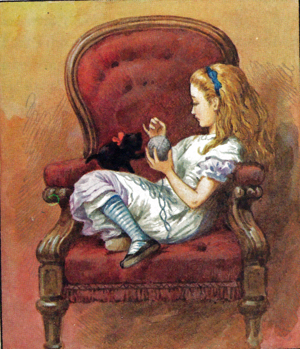
We go to Alice's house, where she discovers that she can
step through a mirror into the "Looking-Glass
World"--a land laid out like a huge chess
The beauty of Lewis Carroll's books is that they appeal to both children and adults, and I wrote this opera in that spirit. His work embodies a child's world of fantasy and make-believe, but one can also find wry commentary on the logical absurdities of language, the violent imagery of fairy-tales, and the foibles of his Oxford colleagues. I hope the work will appeal to whole families.
As Alice moves across the checkerboard land, each new square brings a new character or set of characters into her life. Each character is centered around a specific musical instrument according to the table below. This deliniates the characters and helps more observant children learn about the instruments of the orchestra:
This
could be a world of existential horror, but Lewis Carroll
meets it with a wry and sardonic humor tempered by a deep
sense of kindness and generosity. It is
his compassion for childhood
that gives the books their most beautiful character and
meaning. He reveals the "eternal
child" in all of us. As the
opera closes, Lewis Carroll
simply asks, "Life, what is it but a dream?"
|

 board
inhabited with living chess pieces and amusing characters
from English fairy-tales.
board
inhabited with living chess pieces and amusing characters
from English fairy-tales.