|
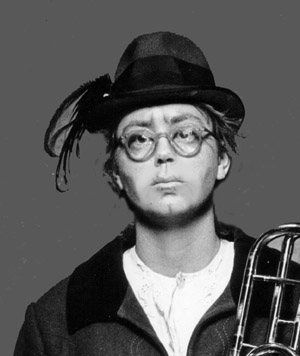
Leonore An old woman sits on a park bench. She talks to the pigeons about her thirty years as an orchestra musician. She occasionally plays a passage for the birds, and ends trying to create her own piece.
Click on the picture to listen to Leonore. (Real Media sound file at 176k)
Click on the picture to listen to Leonore. Abbie Conant, actress and trombonist William Osborne, text and direction
Pond (the trombone solo) was composed by William Osborne and Abbie Conant
Premiered in Munich - Nacht der Experimentelle Musik, November 1983 (The premiere was recorded by the Bavarian State Radio, but the tape was later destroyed.)
If you would like to perform Leonore and/or Pond, please send email and we will email back the text or score free of charge. Our email: william@osborne-conant.org
Notes Leonore was written in reaction to Abbie's experiences in the Munich Philharmonic. Some of the topics the work addresses are still taboo in Germany and Austria. Due to our continuing activism against discrimination in orchestras such as the Vienna and Berlin Philharmonics, and at the conservatory where Abbie teaches, we are strongly ostracized by segments of the German-speaking musical community. I have also written a musicological analysis of orchestral patriarchy entitled "Symphony Orchestras and Artist-Prophets: Cultural Isomorphism and the Allocation of Power in Music. Click here for a version in German. Below are a few excerpts from a recent article about the reception of Goetz Aly's new book Hitler's People's State. It might help those unfamiliar with Germany better understand the reactions Abbie and I have confronted. As Aly notes, German perspectives continue to evolve. It has been 23 years since Leonore was premiered. We know the day will come when a wider spectrum of the German and Austrian music world will approach the ideas the work considers.
How Germans Fell for the
'Feel-Good' Fuehrer
A
well-respected German historian has a radical new theory to explain a nagging
question: Why did average Germans so heartily support the Nazis and Third Reich?
Hitler, says Goetz Aly, was a "feel good dictator," a leader who not
only made Germans feel important, but also made sure they were well cared-for by
the state. "The book could have been written 10 years
ago, even 20 years ago," he says. All of the documents were there. We just
weren't open to them. Personally, I didn't have the questions then. I am
not trying to turn the history of National Socialism on its head," he
insists. "But I think -- despite all the time that has passed -- it is
still important to ask the most fundamental questions, namely how all this
happened. What were the most important elements that allowed this criminal
regime to thrive? So much came out of the German middle class. That is the most
troubling aspect of the history." Current politics seems to mirror this sentiment. These days, making use of an agile word and mind flip, Germans have begun to insist that they -- like the rest of Europe -- were also liberated on May 8, 1945. They say it marks the day they and their children were freed from Nazi oppression. Still, in 1945, says Aly, Germans didn't think they were being liberated. "They had to be liberated from themselves," he says. "That's the problem." [...]
|