Symphony Orchestras and
Published in Leonardo Music Journal (Vol. 9, 1999) M.I.T. Press
The Gender and Ethnic Ideologies of the Vienna Philharmonic
The Appropriation of the Vienna Philharmonic as a National Socialist Propaganda Instrument
Cultural Isomorphism and the Symphony Orchestra
The Ideological Appropriation of the Image of the Artist-Prophet
The Demise of the Artist-Prophet in the Post-Modern World
Abstract
The Vienna Philharmonic is the paradigm of the symphony orchestra. No other orchestra in the world has been so intimately involved with the composers and cultural developments that have defined the genre. In spite of recent protests against the Vienna Philharmonic, it still excludes women and visible members of racial minorities, based on its belief that gender and ethnic uniformity give it aesthetic superiority. The Vienna Philharmonic thus provides an interesting case study for the allocation of power in western art music. In this article the author documents the orchestra's ideologies, and relates them to a general theory that the allocation of power in artistic expression is often culturally isomorphic with the larger values of the society in which that expression occurs. He then discusses how cultural isomorphism affects concepts of power allocation in the Modernist and Post-Modernist mind sets.
There is only one woman among the Vienna Philharmonic's 150 members: their second harpist, Anna Lelkes. After having performed with them unofficially for 26 years, she was given membership in 1997, in order to stem international protest against the orchestra's sexism. Since then, no other women have been allowed into the ensemble. As part of their exclusion of women, they recently prevented a
highly qualified woman candidate from the Berlin Philharmonic, Gertrude Rossbacher--who was born in Vienna and educated at the Wiener Musik Hochschule--from auditioning for an open solo-viola position.[1] [Read the report in the Los Angeles Times.]
In an interview with the West German State Radio, Helmut Zehetner--a 2nd violinist in the the Vienna Philharmonic--noted that the orchestra has a special "emotional unity" as an all-male ensemble that lends its music superior qualities. [Complete Interview.] He was asked about the possible entry of women into the orchestra:
"No, truthfully said, I wouldn't be indifferent. I would have an uneasy feeling in the situation. And that is because we would be gambling with the emotional unity that this organism currently has. My worry is that it would be a step that could never be taken back."[2] And concerning Ms. Lelkes, he added: "We have a male harpist, and two ladies.[3] If you ask how noticeable the gender is with these colleagues, my personal experience is that this instrument is so far at the edge of the orchestra that it doesn't disturb our emotional unity, the unity I would strongly feel, for example, when the orchestra starts really cooking with a Mahler symphony. There, I sense very strongly and simply that only men sit around me. And as I said, I would not want to gamble with this unity." This view was confirmed by Dieter Flury, the orchestra's solo-flutist, who added that ethnic uniformity is also essential:
"From the beginning we have spoken of the special Viennese qualities, of the way music is made here. The way we make music here is not only a technical ability, but also something that has a lot to do with the soul. The soul does not let itself be separated from the cultural roots that we have here in central Europe. And it also doesn't allow itself to be separated from gender. So if one thinks that the world should function by quota regulations, then it is naturally irritating that we are a group of white skinned male musicians, that perform exclusively the music of white skinned male composers. It is a racist and sexist irritation. I believe one must put it that way. If one establishes superficial egalitarianism, one will lose something very significant. Therefore, I am convinced that it is worthwhile to accept this racist and sexist irritation, because something produced by a superficial understanding of human rights would not have the same standards."[4] In addition to the presumed aesthetic purity produced by ethnic and gender uniformity, the Philharmonic excludes people who are visibly members of racial minorities, because they feel such individuals would damage the orchestra's image as an authentic representative of Austrian culture. This view, which is shared by some other Austrian orchestras, has been documented by Dr. Elena Ostleitner, of the Institute for Music Sociology at the Wiener Musik Hochschule. She recorded the following statement by an Asian woman: "I auditioned for an orchestra, and I led in the point tabulations as long as I played behind a screen. Due to my name it was not apparent that I am an Asian. But when the screen was removed, I was rejected without comment. Friends in the orchestra confirmed my assumption. They do not take foreigners, and if they do, then only those in which [foreign appearance] is not visible."[5] Another Viennese sociologist, Prof. Roland Girtler, of the University of Vienna, has made the same observations:
"What I have noticed that is interesting, is that the Vienna Philharmonic would also never take a Japanese or such. If they took one, this also would somehow by appearances put in question the noble character of Viennese culture. But this is not racist!"[6] It is therefore not musical performance, but the racial physiognomy of Asians that is the critical issue--although Girtler does not view this as racist.
Similar views were reported in a radio broadcast of the Austria National Broadcasting Corporation. A public school teacher who had taken his class to a rehearsal of the Vienna Philharmonic reported that a girl in the class asked why only men were in the orchestra. Werner Resel, the orchestra's chairman at the time, answered that the "Vienna Philharmonic is an orchestra of white men playing music by white men for white people".[7] A Strategy for Analysis Among the symphony orchestras of central Europe, the Vienna Philharmonic is not alone in its exclusion of women. Within a 300 mile radius of Vienna, there are seven major orchestras with a 0 to 7% representation of women, as noted in the table below:[8]
[Editorial note. For the 2009 representation of women,
click here. Progress has been made in some orchestras, but most of the new women employs remain in the tutti strings. Few have achieved solo positions.]
Why does the symphony orchestra have such strong gender coding? Why is it often associated with strong cultural nationalism? How did these cultural values evolve? Why are they still maintained? To answer these questions, we must look at the Vienna Philharmonic’s activities during and after the Second World War, and then analyze them from a broader historical perspective. This will illustrate that their current policies of exclusion derive from long-term historical and cultural trends. The Appropriation of the Vienna Philharmonic as a National Socialist Propaganda Instrument Due to its long history of racial and ethnic ideology, the Vienna Philharmonic was easily appropriated and transformed into one of the most active orchestras for the support of National Socialism (Nazism). In 1938, Austria was made part of Germany through the Anschluss, which was euphorically greeted by a wide spectrum of Austrian society. A program was set in motion to "Aryanize" Austrian culture. As a result, Wilhelm Jerger--a contrabassist in the orchestra and a Lieutenant in the Schutzstaffel (SS)--became the chairman of the Vienna Philharmonic. Forty-seven percent of the Vienna Philharmonic's members were National Socialists, and many belonged to the party well before 1938 when it was still illegal in Austria.[9] Six Jewish members of the orchestra died in the concentration camps, and another eleven were able to save their lives by timely migration. Nine additional members were found to be of "mixed race" or "contaminated by kinship" ("Versippte") and reduced to secondary status within the orchestra.[10]
With 47% of the members belonging to the National Socialist Party and 26 "non-Aryans" either murdered, exiled or reduced in status by the Nazi regime, the orchestra clearly exhibited its strong fascist tendencies.
In his memoirs, published in 1970, Otto Strasser, a fromer chairman of the Vienna Philharmonic describes the problems blind auditions caused:
“I hold it for incorrect that today the applicants play behind a screen; an arrangement that was brought in after the Second World War in order to assure objective judgments. I continuously fought against it, especially after I became Chairman of the Philharmonic, because I am convinced that to the artist also belongs the person, that one must not only hear, but also see, in order to judge him in his entire personality. [...] Even a grotesque situation that played itself out after my retirement, was not able to change the situation. An applicant qualified himself as the best, and as the screen was raised, there stood a Japanese before the stunned jury. He was, however, not engaged, because his face did not fit with the ‘Pizzicato-Polka’ of the New Year’s Concert.”
[11] The orchestra's many activities in the service of National Socialism began only days after the Anschluss with a trip to Berlin to perform a concert especially for Hitler under the direction of Wilhelm Furtwaengler . The Anschluss euphoria continued with performances of the "Meistersinger von Nürnberg", again with Furtwaengler, at the Nürnberg Party Days in 1938. Hitler was so pleased with the orchestra's performance and show of devotion, he promised them his personal protection and concern, and made them a yearly fixture at the Nürnberg party rallies.[11] They also made many tours of the occupied areas where it was considered essential to "Germanize" the conquered peoples, including cities such as Krakow, Copenhagen, Den Haag, Amsterdam, Paris, and Dijon. In these capacities and many others, they became one of the most important propaganda instruments of the Party.
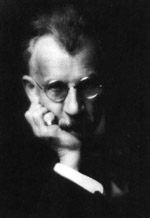
The Vienna Philharmonic's centennial in 1942 and was commemorated with a book by Wilhelm Jerger (pictured right) entitled Erbe und Sendung (Inheritance and Mission). The book documents how ideally suited the orchestras ideologies were to appropriation by National Socialism. It includes the genealogies of several prominent father-to-son generations that formed a historical continuum within the ranks of the Philharmonic, and every "non-Aryan" listed in the tables is indicated with a special asterisk by his name. Jerger explains that the Aryan stock of these Philharmonic families was so "tough" that the purity of their "blood" was never notably damaged by what racists refer to as "dysgenic influences": "And here it is demonstrated, that in spite of manifold influences of blood from elsewhere, this Mind [Geist] continues to implant itself with great toughness through the ancestral lineage, and that it is often very sharply imprinted. It is understandable, that such an inheritance must beget outstanding musicians, who in their stylistic education and in their experience of orchestral playing are already extraordinarily schooled. This is Mind from Old Mind, which helps tradition and inheritance, a dominant trait [überkommene Anlage] to a special development and fulfillment."[12]
Schooling is acknowledged as important, but only in the context of a special "blood" inheritance that transmits "Mind". This follows National Socialism’s ideology of Ahnenerbe, which asserts that cultural traits are genetically inherited. And it seems uncomfortably close to the orchestra's recent comments about the special qualities of the "central European soul”, their attitude toward Asians and notions about music-making revolving around white males. Jerger also presents a racist portrayal of Gustav Mahler, who became the General Music Director of the Vienna Philharmonic in 1898, replacing Hans Richter, who had led the orchestra for the previous 23 years. (The Vienna Philharmonic refers to the Richter years as its "golden age.") Mahler's tenure was troubled in part by a continual pattern of anti-Semitic harassment and he left the orchestra after three years. Using his own words and quoting those of Max Kalbeck, Jerger draws a comparison of Richter and Mahler that reveals the anti-Semitic attitudes Mahler confronted: "A completely different type of personality entered with Mahler, 'as there' -- to speak with Max Kalbeck's vivid words -- 'instead of the tall blond bearded Hun, who placed himself wide and calm before the orchestra like an unshakable, solidly walled tower, there was a gifted shape [begabte Gestalt] balancing over the podium, thin, nervous, and with extraordinarily gangly limbs.' In fact, a greater contrast was really not possible. There the patriarchal Hans Richter in his stolidity and goodness, and his extremely hearty and collegial solidarity with the orchestra, and here Gustav Mahler, oriented to the new objectivity [neue Sachlichkeit] --nervous, hasty, scatty, intellectualish [sic]-the music a pure matter of his overbred intellect."[13]
Unfortunately there is not enough space here to analyze the language ("intellectualish," "overbred," "new objectivity," "gangly limbs," "scatty" vs. "blond," "tall," "stolid," "wide," "calm," and "patriarchal" representing "solidarity") and how it expresses the hallucinogenic ideologies of anti-Semitism and National Socialist aesthetics. The transparent sub text is one of chauvinistic masculinity and genetic superiority. Jerger’s book vividly illustrates how national cultural identity in western art music can be intertwined with sexism, racism, and chauvinistic ethnocentricity.
The post-War de-Nazification of the Vienna Philharmonic was conducted in a disinterested, half-hearted and careless manner. The orchestra argued with singular logic that it had lost so much through "Aryanization" that it could not afford to lose anymore quality through "de-Nazification." The government offered its "complete agreement" for the position, noting: "…the current condition would be bearable, since it was the view that in the interest of the cultural mission of Austria, artists in general, and especially the Vienna Philharmonic, would be subject to a different evaluation than other professional groups."[14]
This lax de-Nazification affected orchestral policy. In 1947, when asked to conduct, Arturo Toscanini refused to work with the orchestra because of the Nazis who remained there, saying he would only change his mind if certain fascists were removed from the ensemble. The Vienna Philharmonic refused.[15]
In 1953 the orchestra caused international concern when it elected a former SS Sergeant and member of the Sicherheitsdienst (the "Security Service" that included the Gestapo) as its executive manager.[17] These actions made it difficult for the Vienna Philharmonic to leave behind its reputation as a "Nazi Orchestra" in spite of its fine music-making.
Though the Vienna Philharmonic maintains gender and ethnic uniformity among its members, they allow for outside influence through guest conductors and soloists. They have found it beneficial to consciously use these guests to rehabilitate the orchestra's public image, while at the same time quietly denying rank and file membership to women and "visible" racial minorities. This has been an effective public relations device for resisting change, and fits with sociological models that suggest that isocratic groups form controlled relationships with outsiders to mutually enhance their image and status.
A study of the Vienna Philharmonic shows that its ideologies allowed it to concentrate and institutionalize beliefs that were common in Germany and Austria decades before the Anschluss, and that this made the Philharmonic an easy and willing target for National Socialist appropriation. What are these "racist and sexist irritations" that are an essential part of "the noble character of Viennese culture" and why do they ask us to tolerate them? Why is it important that "white men perform music by white composers for white people?" Why would the Vienna Philharmonic be damaged if some members were visibly of other races such as Asians? What do they mean by the "Soul" and why is it affected by race and not just education? And why are these values reflected in other symphony orchestras, even if less overtly? We can answer these by examining the orchestra from a larger historical and cultural perspective. Such analysis suggests that that the symphony orchestra is culturally isomorphic with the values of the European societies in which it developed. By cultural isomorphism, I mean the processes by which artistic expression tends to reflect the general cultural and sociopolitical beliefs of its environment. In recent years, sociologists have created numerous models of institution-environment isomorphism that could be very useful for exactly this kind of historical analysis.[18] It is relatively apparent, for example, that a legacy of feudalism influenced European culture well into ninteenth century, and that it still informs the patrician, autocratic, and hierarchical social structures of today's symphony orchestra.[19] Concert dress serves as a simple illustration. In the 18th century, aristocrats employed orchestra musicians in a status similar to household servants, and to this day, male musicians still wear tails for concert clothing, because it was the typical dress of the butlers with whom they were once categorized.
It is also apparent that aristocrats controlled cultural patronage, and that the art they supported reflected their concepts of status, power, and patrician identity. European art thus tended to signify a culturally isomorphic ideology of transcendentally justified autocracy. From the crown of Charlemagne to the Versailles Palace of the Sun King to the literature glorifying British colonialism, the purpose of European art was often to celebrate and strengthen the power and authority of people who thought themselves the recipients of a God-given superiority. In the 19th century, these concepts of genetic, aristocratic superiority were appropriated by the bourgeoisie and transformed into theories of racial supremacy and cultural nationalism.[20] These views, both aristocratic and nationalistic, formulate the heritage of a highly traditional orchestra such as the Vienna Philharmonic, and illustrate why its chairman openly referred to the orchestra as "white men performing white male composers for a white public" --especially in a very conservative, mono-cultural country like post-Empire Austria.[21]
One of the more significant ideologists of Germanic racial supremacy was Houston Stewart Chamberlain whose book Die Grundlagen des Neunzehnten Jahrhunderts (1899) outlined “Aryan” greatness. His Rasse und Persönlichkeit (1925) directly influenced Hitler. He was an admirer of Wagner and wrote Notes sur Lohengrin in 1892. A biography of the composer followed in 1895. In 1907 he settled in Bayreuth and married Wagner’s only daughter Eva.
The rise of 19th century cultural nationalism had a profound affect on the Austro-Hungarian Empire, which began to dissolve as separate national consciousnesses evolved within its peoples, including cultural revivals among Slavs, Italians, and Germans. The writings of Emanuel Kant and his followers (such as Fichte, Hegel, Schopenhauer and Nietsche) imbued this nationalism with a transcendental idealism that emphasized the primacy of the spiritual and intuitive over the material and empirical.[22] These ideas strongly influenced the music of the day and led to a cultural conception that might be referred to as the artist-prophet, a transcendentally inspired hero-artist, who spoke as the voice of "his" nation. Composers such as Wagner, Dvorak, and Verdi, fulfilled such a role, and helped emerging European countries assert their ethnic identity and aspirations to national existence. The ultimate expression of this aesthetic was probably "Bayreuth," which can be likened to a temple for the quasi-religious celebration of national myths and rituals. The Vienna Philharmonic was founded in 1842, specifically as an ensemble to present this new genre of symphonic works. From the very beginning, its ideologies were influenced by the storm of national and patriarchal ethnicity that surrounded it. Transcendentally justified nationalistic mono-culturalism began to inform orchestral ideologies of ethnic uniformity. This 19th century legacy is still revealed today, when the Vienna Philharmonic speaks of its ethnic purity, and the transcendental qualities of its “central European” “soul.”[23]
In The World as Will and Idea (1819), and other influential works that followed, Arthur Schopenhauer created a philosophy which advocated turning away from spirit and reason to the powers of intuition, creativity, and the irrational. This view deeply influenced Nietsche, who in
The Birth of Tradgedy (1872) proclaimed that art and literature must harness Dionysian elements of the irrational. This view created the radical will of Nietsche’s “Superman” in Also Sprach Zarathustra. Schopenhauer and Nietsche profoundly influenced the German cultural realm, ranging from Wagner and Pfitzner to Wedekind and Freud. Misappropriated notions of radical will became part of Fascism’s cult of the hero and contributed to the formulation of radical evil.
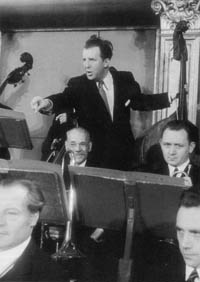
The rise of nationalism in the symphony orchestra developed in tandem with the growing autocracy of the conductor, which was culturally isomorphic with the counter-revolutionary authoritarianism that evolved after the suppression of the 1848 revolts in central Europe. Like the composer, the conductor began to be viewed as an artist-prophet while the orchestra musician became increasingly objectified. Musicians became highly responsive machines, musical constructs, fantasies of the conductor's mind. One of the first great autocratic conductors, Carl Maria von Weber, emerged at this time. Wagner
took his advice on the patriarchal art of conducting, as shown by the quote at the beginning of this section.[24] This concept of the Emperor-Conductor remains to this day, and they are still often attributed transcendental, revelatory powers, correlated with their masculinity.[25] In 1992, the program magazine of the Munich Philharmonic contained the following description of its General Music Director: "Sergiu Celibidache is an extraordinary European, so impressive, because he projects an unobstructed, incorruptible masculine aura. And the world is in great need of this, because we live in a fatherless society, a world without standards in this regard. And there he is, such a man, who does not allow himself to be corrupted and who quite openly expresses--especially during concerts--what is happening inside him, which is, naturally, a deeply moving vision. Listeners and performers can still experience music with him as a revelation."[26]
This is the legacy of the artist-prophet, music as the "revelation" of an "unobstructed masculine aura" in a "fatherless society".[27] The Appropriation of the Orchestra As a Simulacrum of Totalitarian Cultural Nationalism
At the close of the 19th century, the symphony orchestra had thus become culturally isomorphic with the nationalistic and industrial views of the time.[28] The orchestra grew in size, using ever larger groups of musicians to perform orchestral scores that inflamed ethnically determined nationalistic ideologies under conductors who possessed a form of dictatorial power that the music-world had never seen before.[29] In post-revolutionary Germany and Austria, the values of autocracy, and chauvinistic nationalism were dangerously apparent--and via the processes of cultural isomorphism--became increasingly represented in the symphony orchestra as well. It thus seems likely that on a subconscious and metaphorical level, the symbolic rituals of the 19th century symphony orchestra represented one more cultural factor that helped fuel the downward spiral on which the European psyche slid toward National Socialism.
This might explain why in the 1930s, not only the Vienna Philharmonic, but numerous other ensembles (such as the Berlin and Munich Philharmonics) became important propaganda instruments used to reaffirm National Socialism's world view.[30] The symphony orchestra's transcendentally justified authority, human objectification, and cultural nationalism, made it a useful cultural symbol that served as a simulacrum of National Socialist ideology. As Hitler remarked:
"Art is an exalted mission requiring fanaticism. He who is chosen by providence to reveal the soul of a people around him, to let it sound in tones or speak in stone, suffers under the power of the Almighty as a force ruling him, and will speak his language, even if the people do not understand or do not want to understand. And he would prefer to take every affliction upon himself than even once be untrue to the star that guides him internally."[31]
The above suggests that National Socialism was not just the result of transient historical forces, or merely external social circumstances, but also an isomorphic manifestation of long standing Western cultural values. A society whose art venerates ethno-centricity, cultural nationalism, human objectification, and transcendentally justified autocracy, might use them constructively in a symphony orchestra, but it must also acknowledge that the same cultural values can contribute to forms of totalitarianism. A close look at Adolf Hitler reveals that a 19th century aesthetic of Radical Will, ultimately accompanied a 20th century morality of Radical Evil.[32] The Ideological Appropriation of the Image of the Artist-Prophet
To a considerable degree, the twentieth century modernists continued to model themselves on the image of the nineteenth century artist-prophets they claimed to oppose. Generally speaking, they distinguished themselves from the Romantics by bringing a tone of rationalist objectivity to their work, which was culturally isomorphic with the predominantly scientific and technological spirit of the twentieth century. This complex bifurcation between the romantic and objective spirits of modernism formulated some of its most profound artistic expression. One thinks of T.S. Elliot's detached, objective language expressing a world view that ranged from Dante's medieval spirituality to Anglican devotion, or Schönberg and Berg's rigorous theoretical structures enveloping expressionistic emotion, or George Crumb's post-Webern influenced cell-theory capturing the spirit of Lorcian animism, or Pederecki's harshly dissonant early style gradually returning to romantic forms. Perhaps the clearest representation of romantic transcendentalism manifesting itself in the modernist artist-prophet is Karlheinz Stockhausen, who not only played a notable role in the technological development of electronic music, but who also believes that his highly mystical cycle of seven long operas is being completed from a higher plane of consciousness.
This was culturally isomorphic with the modernist continuation of the 19th century concept of the artist-prophet who was viewed as a source of truth and justice, and who was to be followed through a cycle of destruction
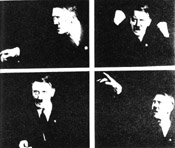
and rebirth. In the land of Bayreuth, Hitler's success depended to a large degree on his ability to blur the borders between the artist-prophet and the absolutist dictator. With his dictatorial melomania, he envisioned the Third Reich as a large work of music theater to an astoundingly literal degree.[34] Fortunately, his Götterdämmerung was more complete than the revolution that he hoped would lead to a new world order of scientifically bred but romantically transcendent supermen.
The larger design of Hitler’s ideology as an artist-prophet included the recreation of humanity according to a new aesthetic. From this perspective, the Holocaust was a work of art, a “purification” of culture, a “sculpting” of the human race. The concept of the artist-prophet brought new creativity to artistic expression, but toward the close of the 19th century it had already developed a tendency toward ideological division and orthodoxy. (This can be seen, for example, in the nationalistic concepts of opera represented by Wagner and Verdi.) The artist-prophet systemized belief by conceptualizing aesthetic ideology, and this became culturally isomorphic with the 20th century's systemic forms of social and economic organization. We saw, for example, a culturally isomorphic essentialisation of art in the "Gleichschaltung"[35] of the Third Reich, in the Social Realism of the East Block, in the comercialization of culture in America, and in the “Cultural Revolution” of Moaist China. Like the political divisions of the 20th century, these aesthetic orthodoxies reduced human expression to systemic concepts that tended toward the formulaic and reductionist, and were often developed by modernist artists in the role of aesthetic prophets who served a more or less transcendentally justified patriarchal function within their societies. These aesthetic systems tended to be culturally isomorphic with the political and economic structures in which they existed, and frequently allowed the artist-prophet or his image to be appropriated by totalitarian social structures. The modernists embraced the 20th century's presumed rationalism, but due to their complex and sometimes destructive relationship with the romantic legacy of the preceding century, they and their cultures often seemed spiritually dispossessed. After the horrors of the Second World War, composers were left searching for new forms of authority in musical expression, and this allowed America to enter the world stage of music for the first time in history. The most influential of these composers was John Cage, who established that all sound could serve as the material of music, which could be presented in aleatoric forms independent of the artist’s will. Due to the historical context, this had a profound effect. War ravaged Europeans knew that the Third Reich was, in part, a manifestation of their cultural values, and this former student of Schönberg offered a new world, an emancipation of sound freed from a genocidal past. But as the Cold War ended, the world's political divisions were softened, as were the ideological divisions in art reflected by modernist artist-prophets, even those such as Cage. As Post-Modernists pressed ever more deeply into the nature of human perception, the authority of knowledge itself was thrown into doubt. They revealed not only its arbitrary forms, but also its confusion, it irresolution, and its subjectivity. This was culturally isomorphic with the complex phenomenological world of post-Newtonian science, which was forced to confront its own tendencies toward rationalist reductionism and pretensions to objective certainty. The Western paradigm of subject-object dichotomies was replaced with an understanding that reality is a complex phenomenological Gestalt, a mutually inter-dependent and ever deepening marriage of Mind and Nature that evokes not only new concepts of truth, but also new forms of beauty. This marriage is bringing a new humanism to both science and art. If the theory of cultural isomorphism is correct, new artistic genres will evolve in the Global Village, that differ from those created by artist-prophets representing the feudalistic, nationalistic, and monolithic political ideologies of European history. Connective technological developments--such as collaborative music composition via the Web and the ability to quickly disseminate and retrieve information worldwide--will generate new concepts of community. Notions of stylistic orthodoxy will be diminished, and disenfranchised groups such as women and minorities, will have greater access to the avenues of power provided by new forms of large scale networking. Advancements such as these will weaken the patriarchal cultural concept of the artist-prophet, and replace the authoritarian, hierarchical social structures of the symphony orchestra that was his instrument. The desire of orchestras such as the Vienna Philharmonic to maintain a historical image of gender and racial purity will represent a dark chapter of the past, a remnant of authoritarian, transcendentally justified, cultural nationalism that ultimately synthezised political and aesthetic ideology into forces of terrifying power. The new social currents that are developing will help western culture avoid the catastrophic fanaticism and zealotry that led the 20th century to brutality, war and genocide.
Endnotes [1] Jan Herman, "For Violist, the Rules Never Seem to Change," The Los Angeles Times (February 27, 1998). [2] The interview material was transcribed and translated by the author from: "Musikalische Misogynie," broadcast by the West German State Radio, February 13, 1996. See also: William Osborne, "Art Is Just An Excuse: Gender Bias in International Orchestras", Journal of the International Alliance for Women in Music, Vol. 2, No. 3, p. 6 (October 1996) [3]The second “lady” is Adelheid Miller who does not play in the Vienna Philharmonic. She works in the Vienna State Opera Orchestra. The members of the State Opera Orchestra run the Vienna Philharmonic as a private enterprise on the side, but Miller was excluded from the Philharmonic due to personal disputes she had with them. She recently retired from the State Opera and has been replaced with another woman harpist, Julie Palloc, who after a three year tenure in the Opera, will qualify for membership in the private Vienna Philharmonic. The Vienna State Opera/Vienna Philharmonic has presented the employment of Palloc as progress, even though they have always used women harpists.
[4] Ibid.
[5] Elena Ostleitner, Liebe, Lust, Last und Lied (Wien, Bundesministerium fuer Unterricht und Kunst, 1995) p. 6. [6] "Musikalische Misogynie," broadcast by the West German State Radio, February 13, 1996.
See also: Roland Girtler, "Mitgliedsaufnahme in den Noblen Bund der Wiener Philharmoniker Als Mannbarkeitsritual", Sociologia Internationalis, Beiheft 1 (1992). [7] "Von Tag zu Tag", broadcast by Austrian National Radio and Television, December 11, 1996, 4:05-4:45pm. The school teacher who witnessed the remark spoke in this program and quoted Resel’s statement. The transcription and translation are by the author. [8] The statistics for the Vienna Symphony Orchestra come from: Elena Ostleitner, Liebe, Lust, Last und Leid, unpublished report (Austrian Bundesministerium fuer Unterricht und Kunst, 1995) p. 62. The statistics for the East German orchestras come from: Jutta Allmendinger, "Staatskultur und Marktkultur: Ostdeutsche Orchester im Vergleich", unpublished working paper (Report No. 2, Cross-National Study of Symphony Orchestras, Harvard University Business School, 1991) table 1. The statistics for the Vienna and Berlin Philharmonics were collected by the author. In Berlin there were four additional women in a trial year. These statistics come from as early as 1991. There has been improvement since then, but the representation of women in these orchestras is still quite low, generally below 10%. Almost all of the women play in the tutti strings.
[9] Clemens Hellsberg, Demokratie der Koenige: Die Geschichte der Wiener Philharmoniker (Zurich: Schweizer Verlagshaus: Wien: Kremayr & Scheriau; Mainz: Musikverlag Schott, 1992) p. 464.
Hellsberg is the Chairman of the Vienna Philharmonic. His book is relatively open in discussing the orchestra's collaboration with National Socialism, but his remarks often have a rationalizing tone. [10] Ibid. p. 505. [11] Ibid. p. 464.
[12] Wilhelm Jerger, Erbe und Sendung (Wien: Wiener Verlag Ernst Sopper & Karl Bauer, 1942) p. 87.
Copies of this book are rare. Thanks to Manuela Schreibmaier for finding and making a copy available to me. [13] Ibid. p. 57. [14] Ibid. p. 510.
[15] Ibid. p. 518.
[16] Erwin Kroll, "Der Warthegau huldigt Pfitzner. Allgemeine Musikzeitung, Leipzig (LXIX/10, September 18, 1942; as quoted in: Prieberg, Fred K., Musik im NS-Staat (Frankfurt am Main: Fischer Taschenbuch Verlag, 1982) p. 224.
See also: Hellsberg, 549-551. Hellsberg lists the support for Pfitzner as a humane act and as a "milestone" in the orchestra's history. [17] Hellsberg, p. 514. [18] These models could also define how institutions stand in opposition to their environment, or how they can become frozen at a certain point in time. To my knowledge, the term cultural isomorphism is my own invention. I derived it from sociological models of institution-environment relations. For a study using institution-environment models applied to the contemporary symphony orchestras of former East Germany see: Jutta Allmendinger and J. Richard Hackman, "Organizations in Changing Environments: The Case of East German Symphony Orchestras", Administrative Science Quarterly, No. 41, pp. 337-369, Cornell University (1996). See also: Arthur L. Stinchcombe, "Social structure and organizations" in James G. March (ed.), Handbook of Organizations (Chicago: Rand McNally, 1965) pp. 142-149. And: Paul J. DiMaggio and Walter W. Powell, "The iron cage revisited: Institutional isomorphism and collective rationality in organizational fields", American Sociological Review, No. 48, pp. 147-160 (1983). The theory could also be related to the sociology of knowledge as developed by writers ranging from Marx to Habermas. A specific relationship exists to the early writings of Adorno which emphasize aesthetic development as important to historical evolution and the search for “truth”. [19] Feudalism was a political and economic system of Europe from the 9th to about the 15th century, characterized by vassalage. The term is also commonly used to refer to a political, economic, or social order resembling this medieval system. In this article, I refer to feudalism’s cultural legacy which shaped Europe well into the 19th century. [20] One of the more significant ideologists of Germanic racial supremacy was Houston Stewart Chamberlain whose book Die Grundlagen des Neunzehnten Jahrhunderts (1899) outlined “Aryan” greatness. His Rasse und Persönlichkeit (1925) directly influenced Hitler. He was an admirer of Wagner and wrote Notes sur Lohengrin in 1892. A biography of the composer followed in 1895. In 1907 he settled in Bayreuth and married Wagner’s only daughter Eva. [21] Similar views inform the reception of classical music well beyond Austria. The musicologist Pamela M. Potter suggests that this might be attributed to vestigial, unconscious attitudes of Germanic cultural supremacy. See Pamela M. Potter, Most German of the Arts (New Haven: Yale University Press, 1998) p. 260. [22] For a useful discussion of these authors see: Peter Pulzer, Germany, 1870-1945: Politics, State Formation, and War (Oxford, Oxford University Press, 1997). [23] In reality, the orchestra consciously excludes people from many central European countries, particularly those that are non-German speaking.
[24] "Nicht Kaiser und nicht Koenig, aber so dastehen und dirigieren." Carl Dalhaus has described the conductor as half Field Marshall and half magician: "In der imperialen Geste des Kapellmeisters, steckt die Gebaerde des Feldherrn, der ueber seine Truppen gebietet, und zugleich die des Zauberers, der ein Wunderreich, E.T.A. Hoffmanns Dschinnistan, beshwoert." [25] Regarding conductors in US schools of music, Christina McElroy found that at the end of the 1984-1994 period of her study: 97.7% of all professors were male; 95.5% of all associate professors were male; 91.3% of all assistant professors were male. See: Christina McElroy, "The Status of Women Orchestra and Band Conductors in North American Colleges and Universities: 1984-1996" (#9717189, UMI).
[26] Joerg Eggebrecht, "Reise ins Herz," Philharmonische Blaetter, 91/92 Jahrgang 7, Heft 6, p. 14 (February/March 1992). [27] Juliet Flower MacCannell argues that fascism is not patriarchal or related to the father, but has to do with phantasmic fraternalism. See: Juilet Flower MacCannell, The Regime of the Brother: After the Patriarchy (London and New York: Routledge, 1991).
In his book, Klaus Theweleit, Männerphantasien, Band 2: Männerkörper.
Zur Psychoanalyse des weißen Terrors (München, 1995) examines the role Germany’s Männerbündelei (men’s groups) played in the development of fascism. The Holocaust scholar, Daniel Goldhagen, Hitler's Willing Executioners (New York: Alfred A. Knopf, 1996) p. 248, describes how a group of soldiers in a Wehrmacht Police Battalion that regularly committed acts of genocide, suddenly felt moral conflicts about their actions when the wife of one of the officers was present. [28] In his book, Jacques Attali, Noise: The Political Economy of Music (Manchester University Press, 1985) argues that music has consistently foreshadowed the economic developments of society. For a highly readable and fascinating account of late 19th century Europe's progress toward the First World War see: Barbara Tuchman, The Proud Tower (New York and London: The Macmillan Company, 1966). [29] There were additional reasons the size of the orchestra was expanded, such as the creation of sonic environments reflecting the expansiveness of nature, but these portrayals often also contained nationalistic overtones, such as in Strauss’s “Alpine Symphony”. [30] Information about the NS use of the Berlin Philharmonic and the Bruckner Orchestra can be found in: Fred K. Prieberg, Musik im NS-Staat (Frankfurt am Main: Fischer Taschenbuch Verlag, 1982). The Munich Philharmonic was known as "The Orchestra of the Capital City of the Fascist Movement" and stamped all of its music with those words circumscribing an eagle holding a Swastika in its talons. In 1991 I had to write two letters to the Munich Cultural Ministry in order to have the Swastikas removed from the orchestra's old music which was still in regular use.
[31] "Kulturrede beim Reichsparteitag 1933 in Nürnberg," Baustein zum National-theater I/3 (December 1933) p. 67. [32] Thomas Mann was one of the first to note that Hitler presented himself to the German people as a myth-making artist. As cited in Gordon Craig, The Germans (New York: Meridian Books, 1982) p. 67. [33] In The World as Will and Idea (1819), and other influential works that followed, Arthur Schopenhauer created a philosophy which advocated turning away from spirit and reason to the powers of intuition, creativity, and the irrational. This view deeply influenced Nietsche, who in The Birth of Tradgedy (1872) proclaimed that art and literature must harness Dionysian elements of the irrational in order to exist. This view led to the radical will of Nietsche’s “superman” in Also Sprach Zarathustra. Schopenhauer and Nietsche profoundly influenced the German cultural realm, ranging from Wagner and Pfitzner to Wedekind and Freud. Misappropriated notions of radical will became part of Fascism’s cult of the hero and formulated actions describable as radical evil. For perspectives on the concept and history of radical evil see the anthology: Joan Copjec, ed., Radical Evil (London and New York: Verso, 1996). [34] In his book, John Toland, Adof Hitler (New York: Doubleday, 1976) p. 22 documents an eye witness account of how even as a young man Hitler went into a political trance upon his first hearing of Rienzi and spoke of the mission he had before him. On pages 35 and 36 he documents that Hitler spent several weeks working on an opera libretto based on Wieland the Smith after he learned that an outline of a music drama based on it had been found in Wagner's posthumous papers. In his Introduction to his translation of Mein Kampf, Ralph Manheim notes that the main source of Hitler's pet phrases was the theater and the opera. Hitler was a regular presence at Bayreuth, and a personal apartment was built for him on the grounds. It is still there.
[35] Gleichschaltung was the policy of forcing all cultural, intellectual, and social activity in the Third Reich into conformity with the ideologies of National Socialism. |