Cybeline
(a multimedia music theater work for trombonist/performance artist)
Table of Contents
2. Score
3. Trailer
4. YouTube Video (complete work)
5. Slide Show
7. An Essay About Cybeline, Culture, and Technology
8. synopsis
9.
Programmhinweise für Cybeline

1.
General Description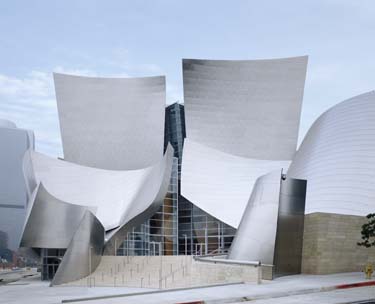
A music theater work for performance-artist/instrumentalist, glove controller, video, and quadraphonic tape. (45 minutes) Premiere: REDCAT Theater in Disney Hall, Los Angeles, March 16, 2004.
Abbie Conant: performance-artist, libretto and cartoons. William Osborne: music, video, direction
Cybeline is a music theater work about a cyborg trying to be a talk show host to prove she is human. It is about nature, virtual reality, biotechnology, and the mass media – and about finding the heart and poetry in technology as it also contemplates its horrors. We explore our notion that the creation of a cyborg does not depend on the metalization of the body, but on the programmability of the mind. We live in a wired together, prosthetic world of global “cyberbia“ where our minds are programmed by the mass media. Since our minds are programmed, we are all cyborgs. Cybeline can project her thoughts, both conscious and unconscious, directly onto a screen that is an extension of her body. She uses this ability to create her show. A loud buzzer switches her on and off the air. All is integrated into a 45 minute surround-sound mini opera with computer-generated accompaniment, video and live electronics.
2. Score
To download the PDF score of Cybeline click here. (3.6 megs) The PDF file is almost illegible on a computer screen, but prints beautifully. The score is on legal size paper (8.5 x 14 inches.) Europeans can use A3 paper and trim the score to size after printing.
To download the complete PDF text of Cybeline click here.
3. Trailer of old DV version from 2004. (3:30)
4. The YouTube Video (Complete Work) in HD.
5. Slide Show
50 images from Cybeline
6. Program Notes (Klicken Sie hier für Deutsch)
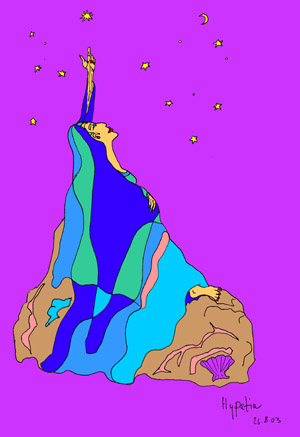 Cybeline
was premiered in 2004 in Los Angeles in the REDCAT Theater of Disney Hall
under the auspeices of CalArts.
It is a multimedia music theater film
about a cyborg trying to be a talk show host so she can prove she is
human. The
work begins with Cybeline’s showbiz antics, but as her awareness grows she
strives toward spirituality and transcendence which is given an ironic
tone by her cyborgian nature.
Cybeline
was premiered in 2004 in Los Angeles in the REDCAT Theater of Disney Hall
under the auspeices of CalArts.
It is a multimedia music theater film
about a cyborg trying to be a talk show host so she can prove she is
human. The
work begins with Cybeline’s showbiz antics, but as her awareness grows she
strives toward spirituality and transcendence which is given an ironic
tone by her cyborgian nature.
Cybeline’s existence is
divided between two worlds separated by a loud switch: 1) her online existence
of cyborgian showbiz; and 2) her off-line biological world, which is
dream-like, random, animistic, and surrounded by whispered thoughts she hears
in her head. Part
of her cyborg nature is a digital glove that controls a synthesizer.
As
the work progresses, she reports about a person named Maxine O’Donnell who was
murdered and dismembered then put back together as a cyborg.
As Cybeline gradually regains the memories
of when she was a human, there are increasing hints that she is actually
Maxine.
The work explores the masculinization of technology, including its close
association with militarism. The
Ars Electronica Festival in 2000 was entitled “Next Sex” and provides a good
example. It embraced a future where humans will be “fabricated,” and where
sex will be “relieved of its functional indispensability for reproduction.”
One presenter, Stahl Stenslie, said that “even rape can be an art
creational strategy,” a view that was also printed in the festival’s program
booklet. Evolutionary biologist Randy Thornhill, author of the controversial
book “A Natural History of Rape,” presented a lecture asserting that rape is a
natural part of male sexuality, and that women should restrict their behavior
to avoid this “natural” phenomenon.
Researchers from Massachusetts General Hospital, in Boston, presented a
project entitled “Tissue Culture & Art(ifical) Wombs.” Their goal is to use
tissue culture and tissue engineering as a medium for artistic expression.
They have created what they call “semi-living” dolls.
Researchers from the Faculty of Medicine at the University of Tokyo,
presented a lecture about their attempts to replace women by creating
artificial placentas.
Cybeline attempts an
alternative view, that there is no body/mind duality, that they are a single,
inseparable whole.
Technology must advance but be integrated
and in harmony with our natural environment and the biological nature of our
being.
There is a specific reason
Cybeline’s world is represented with childlike drawings.
As children our brains encounter an
amorphous world they slowly learn to “paint” into concrete shapes derived from
archetypes that formulate the basis of the human mind, the hard wired,
biologically conditioned phenomenological hologram that is our world.
As a cyborg, Cybeline has been programmed to
begin this process of creating a solid world out of amorphous archetypes,
though in some ways she doesn’t want to let her childhood go.
At night we dream entire
worlds that include even memories of things that never happened.
When we awaken, we assume our brains cease
to create our world but of course that is not true.
We live in a dream that is only a tiny
sliver of reality and thus full of profound existential mysteries we cannot
decipher.
Like Cybeline, this dream is the best our
brains can do as we encounter clouds of amorphous, random sound and imagery.
Then the switch is flipped and we’re in the
“real” world which is in reality a social construct, a kind of showbiz where
we all pretend we know what we are and what we are doing.
In the constantly
turbulent, flowing imagery of Cybeline’s mind, we see how water comprises
about 60% of the machine the runs the human animal, and that our existence and
perception of a constantly flowing and transforming world might derive from
our nature as water beings.
We cannot immortalize ourselves through the
metallization of the body.
It is our water-like, constantly
transforming ephemerality that creates the renewal and growth of the human
species.
It gives birth to the eternal child that is
the true greatness of humanity.
Cybeline also explores how
the internet has become the new opiate of society, a drug-like simulation of
reality and human relationships.
Hence allusions to the type of
hallucinigenic imagery of the 1960s Beatles animation film, The Yellow
Submarine which was also about a drugged culture.
Cybeline also derives from
our activism in the 1990s to bring women into the Vienna Philharmonic.
We used the early days of the web to raise
what was probably the first major internet protest to ever exist. (!)
It was done through the common format at the
time, email discussions groups, and spread virally on the web because
countless people began forwarding our posts to other groups.
In the mid 90s, the web was
still an open, almost anarchic place.
There was no Google, no Amazon, almost no
newspaper websites, no social media, but journalists all over the world
followed our posts on these email discussion groups and began writing
articles.
International protests arose that led the
Vienna Philharmonic to accept women.
(Twenty-five years later, women now comprise
about 15% of the orchestra which is very happy to have them.)
When we wrote, drew, and
composed Cybeline, we were among the first to experience the dichotomies of
off- and online worlds, the stress and personal repercussions it causes, and
how the internet would become a powerful tool for shaping society.
Even though social media as we know it today
didn’t yet exist, we saw how it would change society.
This is another reason Cybeline struggles
with the dichotomies of her on- and offline worlds that are separated by an
increasingly loud industrial switch, an existence created by media which the
social philosopher Jean Baudrillard has called a simulation of reality.
7. An Essay
Cybeline, Culture, and Technology
Printer friendly version of this essay.
A General Description of Cybeline
Cybeline As An Embodiment of the Goddess Cybele
The Cyborg As A Programmable Mind
Cyborgian Longings for Schubert
Technology and the Nihilistic Surrender of the Self
The Self-Enculturation of the Cyborg
A General Description of Cybeline
Cybeline is a music theater work about a cyborg trying to be a talk show host to prove she is human. It is about nature, virtual reality, biotechnology, and the mass media -- and about finding the heart and poetry in technology as it also contemplates its horrors.
Cybeline has two modes, on-line and off-line, abruptly separated by a loud buzzer. Her producers/programmers toggle her between these two modes. When on-line, the pace of her routines are relentless, emulating the frenetic character of video cuts used by commercial television. When off-line she enters a dream-like world where the music is partially determined by random operations that sound vaguely like “the music of nature.” The music is different for every performance.
During the off-air random music Cybeline hears almost imperceptible random whispers coming from all around her that become increasingly present as the work progresses. She doesn't know what they are, but chooses to perceives them as the many voices of the Goddess.
Cybeline As An Embodiment of the Goddess Cybele
Cybeline derives her name from the Goddess Cybele who was brought to Rome from Phrygia in 204 B.C. Her temple stood on the Vatican, where St. Peter’s Basilica stands today, up to the 4th century A.D. when Christians took it over. Roman emperors like Augustus, Claudius, and Antoninus Pius regarded her as the supreme deity of the empire. Augustus established his home facing her temple.
In the 4th century, Christians relentlessly destroyed the religious beliefs surrounding Cybele. St. Augustine called her a harlot mother, “the mother, not of the gods, but of the demons.” One of her names, Antaea, made her the mythical mother of the earth-giant Antaeus, who was invincible as long as his feet remained in contact with his Mother’s body, the earth. Hercules conquered him by holding him up in the air. Churchmen believed the powers of "witches" came from the same sort of contact with the Mother Earth. Arresting officers often carried them to prison in a large basket, so their feet would not touch the ground.
We are especially interested in Cybele’s embodiment as an Earth Goddess, and the dialectic this creates with our culture’s conceptions of technology. What is the voice of the Goddess in a cyborgian world, and especially a goddess associated with the power of nature?
The Cyborg As A Programmable Mind
In Cybeline, we explore our notion that the creation of a cyborg does not depend on the metalization of the body, but on the programmability of the mind. We live in a wired together, prosthetic world of global “cyberbia“ where our minds are programmed by the mass media. Since our minds are programmed we are all cyborgs.
Our culture’s concept that humans can be transformed to cyborgs is a manifestation of a 2000-year tradition of viewing the universe as mechanical. In the eyes of the Western mind, the Goddess Techne shapes the universe with her celestial mechanics. This deeply rooted mechanical orientation has profoundly influenced our understanding of what humans are and deeply informs our cultural expression, hence the understanding that society itself is a massive wired-together cyborg that is programmed by the media.
In a sense, humans have always been cyborgs because they have always programmed their minds, at least partially, through enculturation. Our reality is to a large degree a Gestalt of conscious and unconscious aesthetic decisions shaped by our personal cultivation and the culture we live in. Those who think of themselves as purely rational are deluded because they do not understand that whether they choose the light or the dark, the capitalist or the communist, the feminine or masculine, the literary or scientific, the reality they experience is not so much based on rational observation as it is a culturally determined aesthetic predilection.
When we become conscious of the relationship between aesthetics and the very nature of reality or Mind, we understand that we shape new worlds through the creation of art. It is alchemy, and in a sense, humans themselves are the ultimate artistic creation. There is little difference between what humans call themselves and the aesthetic framework in which they exist. We create our own human identity. Through these mechanisms the cyborg is born. It has nothing to do with the metalization or digitalization of the body, but with programming Mind.
Many composers, such as Bach, Beethoven, Mozart, Schumann, Wagner and Mahler seem to have understood that Mind creates reality. One senses that at moments they knew they composed not merely music, but the web of existence itself. Works such as the Art of the Fugue, Beethoven's Ninth Symphony and his late quartets, The Magic Flute, Mozart's Requiem, Parsifal or Mahler’s Das Lied von der Erde, all hint that Mind and Nature are not a duality, but a unity. These composers felt they composed their destiny. In some strange alchemy, they felt that Mind creates substance.
Due to the nature of enculturation, the relationship between art and reality might thus be defined by the cyclical formula: art creates humanity creates art. These thoughts relate to our culture’s mythological concept that humans were made in the image of God. The universe and humankind are a reflection of each other. Mind and Nature are caught in a mutually self-regenerating cycle. This seems to lie behind the idea of mind and substance interacting in the self-creation of human identity as the cyborg. Humans create cyborgs in their own image, just as "God" created humans in “his.” In this sense, consciousness does not merely perceive substance but creates it. For the cyborg, Mind and Nature are one and the same, a mutually self-recreating unity. A simple illustration of this concept is the way we create media images that flow into our minds, which in turn create our minds. A cycle is set in motion that partially creates our reality.
Through the unity of Mind and Nature the human vanishes into the cyborg, and the cyborg vanishes into the human. Through art we weave not just perception, but the very substance of being. The wire was made flesh, and the flesh was made wire. The human and the cyborg meld in the sacred marriage of Mind and Nature. This is the religion of the cyborg.
Cyborgian Longings for Schubert
We quote Schubert's Lieder in "Cybeline" because they seem to symbolize a historic change in the understanding of Mind and Nature. An urban bourgeoisie had evolved that was no longer directly connected to nature as in previous generations. For centuries the ruling elite of Europe had revolved around an aristocracy that was essentially a landed gentry whose livelihood was often related to forestry and farming. In effect, nature was their livelihood.
With the rise of an industrialized, urban bourgeoisie, the relationship to nature was changed. The demise of Europe’s feudalistic social structures created an urban world in which nature became a weekend luxury, something artificial and removed, something viewed from the distance surrounded by a seemingly artificial rustic romanticism that one could only long for. Schubert’s Lieder are imbued with this urban, industrial ethos that romanticized nature.
Urban industrialization initiated a transformation in our view of human identity. With society increasingly mechanized, a tendency grew to view the human as also mechanical, a factory worker who was an extension and servant of a world mechanized both economically and socially. Scientific thought moved toward a corresponding view of the human as a sort of hardwired biological mechanism. It was probably at about this time that the soul of the cyborg was born, a hardwired mechanical laborer and consumer who freed himself from feudalism by constructing himself as a machine -- even if it meant being cast from nature's romantic garden of Eden.
Schubert
did not foresee the horrific bestiality scientism and biological reductionism
would bring. The "total
wars" that arrived 90 years later and the Holocaust were still beyond
human imagination. When they
arrived, the Nazis literally saw war as a Nietzschian celebration of the
mechanized world. And ironically,
this was to be a form of social cleansing restoring the "natural,"
purified social order that Schubert's vision of nature was seen as portraying.
We now view the future human in a body that is largely prosthetic, living in one giant urbanized construction called cyberbia created by the prosthetic social relationships of the Internet, a borderless, libertarian world that will be the new Eden. Schubert's music comes to us with an almost sickening sweetness, something foreign to the new human: a machine with a Darwinist nature that runs on the acids of batteries, with steel limbs for bone and copper wire for nerves. Through the ironies of the Western traditions of highly measured, mechanically oriented music, which includes even Schubert's Lieder, we long for the rustic "natural" world of a bygone time.
Technology and the Nihilistic Surrender of the Self
Nihilism lies at the root of fascism, the surrender and abnegation of the self to idealized authority. The cyborg can be based on a similar nihilistic view of human life, one surrendered to be recreated according to the authority of an aestheticized and absolute ideal. The ethos of the cyborg and fascism can thus share a common ground: a nihilistic view of life that surrenders itself to aestheticized ideals of perfection.
This helps account for the character of Nazis as cyborgian martinets and automatons. It also explains their eugenics program to create a perfect race. Self is vanquished to authority, and human life becomes clay in the artist-prophet’s hands. Humanity becomes a work of art, one of the first manifestations of cyberbia. Ironically, this was done under Nazi ideologies that also espoused a Romantic and Rousseauean return to “natural,” non-urbanized forms of society. Nature is not merely natural; it is also a programmed social construct.
The history of 20th century Germany revealed with special clarity that under the social engineering of the military, the human becomes a consciously programmed construct, or cyborg. As such, humans are not served by the media but are a part of its apparatus, “cyberbia.” A form of cultural isomorphism is created and society itself becomes a programmable cyborg. This is the fascistic reduction of human society, the mass programming of a culture, its reduction to simplistic ideals generally formulating social identity based on slogans and the unifying forces of hatred. Strength through joy, Blut und Boden, and Lebensraum were common slogans during the Third Reich, but ultimately, media sound bites such as Weapons of Mass Destruction, Liberation, Support Our Troops, and War On Terrorism could have a similarly reductive and imperialistic effect.
America’s all-volunteer military had to embrace advertising since it needed to compete for human resources in a free market. It also has to manipulate the media to win propaganda wars. The military has thus entered the cultural wars of society. Since the military's resources are unparalleled, its ability to conduct a cultural war on its own people is without comparison. Be all that you can be. An Army of One. A few good men. Join the navy and see the world. Under the military-industrial complex’s massive social engineering, war has become the unifying force of American society.
The Cyborg and Chaos
Penelope, Pan, and Pandora are coded as chaos and our enemies. They are symbols of nature and the feminine, or chaos to be conquered and tamed. By contrast, Asian cultures often see chaos as the essential aspect of nature and the source of its beauty and profundity. In the West, we code ephemerality as feminine, which is negative, and thus blind ourselves to many elements of the profound beauty of existence. Or at best we acknowledge ephemerality and chaos as a seductive temptresses, sirens of the night calling us to the waters and the wild. If the essence of existence is indeed nothingness, chaos, and ephemerality, how does this relate to the nihilistic surrender of the self to a cyborgian identity presumably created in the image of a finite and absolute ideal?
Where is the beauty of chaos in the idealized and absolutely defined image of the cyborg? What is left of the ephemeral beauty of nature if we reproduce ourselves in the controlled aesthetic of the cyborg? What is life imprisoned in a perfect ideal?
In this sense, our musical culture, which is more metric and strict than any others, might limit our understanding of existence. We can't understand the ultimate meanings of life by attempting to quantify it. We can only understand life by accepting that it is an unfathomable mystery with which we are one. This should not only influence our philosophy, but also our science and art. If we are to create ourselves in the image of the cyborg in any meaningful way, we must find out how to lend our prosthetic form of existence the chaos and ephemerality of being.
When Cybeline goes off-air and is no longer programmed by enculturating media, her being and the music that surrounds her becomes shaped by random operations, the chaotic panolog of being, the magic chimes of nature. Or as she puts it, “Crystals and clouds at the bottom of the Alchemist’s cup, the dregs of a half-evaporated dream.”
To create the cyborg in the image of our own infinite potential, we must understand the meaning of the darkness and chaos that surrounds us, that is to be cultivated as our best friend, as the mother of our existence, as something to be treated with reverence, as something that we will never conquer, as something that is the source of beauty, knowledge and growth. Nothingness, chaos and ephemerality shape the clouds and the light upon the mountains, they shape the forms of the galaxies and created the mutations that brought human life to existence, they shape the events of our days and call forth the moment of our death. Both Mind and Nature are the wellspring of these forms. We are inseparably bound with them like a child in the womb. The nothingness, chaos and ephemerality of life define the nature of our being, the unity of mind and nature. They are the wellspring of love that unites us with the universe. To fully exist, the cyborg must be invested with the chaos and ephemerality of being.
The Self-Enculturation of the Cyborg
Due to our enmity toward chaos, nothingness and ephemerality, our understanding of both nature and the cyborg is based on the false premise that life is quantifiable. If we are to create a cyborg, we must create a being that embraces and reflects the unfathomability of the universe and emanates from its chaos and ephemerality just as we do.
Artists become “immortal” when their work aligns with the larger forces of history. If our culture (or collective Mind) had taken a radical turn away from the technological definition of the human and universe, the music of Bach would have remained forgotten. Instead, Techne's rule became even stronger, much to the benefit of Bach's mechanistic understanding of the world. Since Bach was aligned with Techne’s overwhelming force of cultural isomorphism, he became destined for greatness, a part of a much larger force of cultural history that created a mechanistic understanding of human identity and nature.
It is through culture that we attempt to understand ourselves and the chaos and ephemerality of being. We wear culture like a mask that is also a magic mirror we look into to define ourselves. This mask we call culture is the persona of individuals and societies, a definition of themselves and the world around them. We are beings that create endless masks of enculturation through which we look at the universe and ourselves. These masks created by enculturation reflect the profundity of the universe and are the wellspring of our growth and creativity.
Artists
also shatter the masks of culture in order to present new forms of
consciousness. They continually
attempt to reprogram our cultural persona.
How will a cyborg embrace the chaos, nothingness and ephemerality of the universe? How will it create its own mask through which it can contemplate the universe's profundity? How will this mask lend the cyborg culture: a magic mirror in which it can look at both itself and the world?
The cyborg will eventually create itself by creating culture. Only when it can continually recreate its own cultural identity will the cyborg grow and evolve. The cyborg will become autonomous the moment it creates culture, a mask-like construct of its own being, a magic mirror of the universe through which it contemplates its self. This is Cybeline's quest as a talk show host.
Technology and Gender
Mechanization, regimentation, and militarism are cultural expressions that are often programmed into the cyborg’s mind, along with a generalized contempt for the coded feminine attributes of chaos, nothingness, and ephemerality.
Due to feminism's experience in developing strategies against patriarchal objectification, its modes of thought provide hints for opposing the nihilistic and fascist objectification of the self as cyborg. These thoughts also relate to women's bodies and their music-making. Due to the characteristics of our gender culture, women are more likely to use or even celebrate their bodies on stage. This aspect of our gender culture stands in opposition to the cyborg as a disembodied artifice of masculinist technology.
Cybeline thus touches on how technology shapes or programs our concepts of gender. Since technology has a male orientation, conflicts evolve as we redefine the body with technology. How does a masculinist technology relate to traditional patriarchal views of women? What is a woman cyborg in this masculinist view?
Ars Electronica’s recent “Next Sex” festival, devoted to bio-technology, seemed to confirm traditional patriarchal views of technology: being a woman is a biological curse; the womb represents a chaotic force of nature which must be tamed; woman is a receptacle for the “natural” desire of rape; she is a half-living doll to be played with; she carries a burden of womanhood that can only be lifted by dismembering and re-engineering her body to effect a leap to men’s self-appointed status of creative autonomy.
One of our goals is to explore the culture of technology with the hope of creating more balanced and complete views, and show that the relationships between humans and technology are indefinably complex. What does a fifty-year-old structure of silicon have to teach a five billion year old structure of carbon?
Maybe one goal for art in science is not integration, but subversion. Maybe art needs to create a science that is less dualistic and bi-polar, less reductive, less certain about "natural law," a science that doesn't live in the vectoral, phallic world of plus and minus, a science that embraces and protects the endless, incomprehensible complexities of the universe as if they were our best friend, the mother of life.
Women will gain equality with men only when we have created aesthetic frameworks that allow for their equality. At this point, we can hardly imagine a world in which the feminine aspects of the universe are given respect equal to the masculine. When we do it will change our science, our governments, our religions, our philosophies, our established art forms, and every other aspect of reality. Obviously, artists play a central role in transforming the aesthetic foundations of cultures. Through art we create new consciousness, and this allows for the creation of a more just and truthful world. Humanity creates art and art creates humanity. Humans create themselves. We are all cyborgs.
8. Synopsis of Cybeline
Cybeline begins with a dream where she sees a TV test pattern from the USA in the 1950s and 60s. It slowly turns into a frantic collage of images that are part of her personality—like an overture to her performance.
A switch is flipped
that puts her online.
She greets her talk show audience and
is then switched offline.
She asks her technician to turn her
sound up and make the applause more real.
Switched back online,
she interviews Hildegard von Bingen about her praying, composing,
doctoring, and herbs.
She jokes about Hildegard’s big
comeback in the 1990s, and asks for intimate details about the Pope.
Switched offline, she talks about the days when
she didn’t need all these gizmos like her digital glove.
Switched online,
there is a commercial for Toss-A-Chip, a plug-in that can give people
new personalities.
She goes through a humorous rendition
of Cyborg’s Top Ten Pet Peeves (software crushes, stinky silicone, sim
sex, etc.) —a parody of a common talk show routine.
The worst peeve is defaulting to
silence. The
switch is flipped and she is taken offline and put to sleep.
She is switched back on and interviews Hypatia,
the ancient Greek mathematician of Alexandria slain by a mob of
Christians.
Switched offline, she talks about hearing
strange voices and sounds in her wires: humming birds and butterflies,
“the bird breast soft callings of the old she gods.”
Switched back online,
there is an ad for Tech Flesh which increases the owner’s capacity as a
DNA docking station.
She then presents the Song of the
Week, which is entitled “Number Crunchin’ Cowboy.” It’s a
country-western song full of humorous word play about computer geeks who
think they’re cowboys.
Switched offline, she
complains that her producers aren’t happy with her.
She says that humans are comprised of
three equal parts: sensation, memory, and showbiz, so what better way to
prove she’s a human than by being a singing and dancing talk show host.
Switched back on, she
sings about a geek who thought computers could become opera singers, but
a soprano broke through security and squashed him.
She sings a Schubert song to prove she
is human, though it seems to have an ironic meaning: “If I had a
thousand arms, I could turn the wheel even faster…”
The switch cuts her
off and she protests because the song wasn’t finished.
She wonders if even her producers are
just equations too.
She is put back
online.
There’s an ad for a robot called
Police Dog.
She presents a segment called True
Crimes, about Maxine O’Donnell who met a manager at a tech company.
The music builds ominously as if the
manager is about to do something terrible, but she is cut off by the
switch.
Offline, she asks,
“Even if I could go back in time, what would I change?”
She is flooded with dreamlike memories
of images and sounds from her childhood:
Maybe to feel the child’s fearlessness
among the wild horses.
She is switched back
online, and humorously protests that “Bill” is turning her on too
strongly.
She reveals that she overheard her
producers talking about how she is some sort of experiment or mistake, a
process of healing transformed into a project of bio-molecular design.
She breaks into another Schubert song:
“That the fairest master might see, How faithful I can be.”
She is suddenly
switched off and says she can hear her body’s cells talking to one
another, like millions of nano-bells so small that lady bugs could wear
them around their ankles, and sometimes like the groaning of an old
Airedale.
She concludes that music is a cyborg’s
dream, like images painted on window glass.
Switched back on, her
images are distorted.
She is ordered to do the True Crimes
segment again, but nicer.
She does it again, differently, but it
still builds ominously, and she is cut off.
Switched off, she comments that humans do not
know the torment of endless knowledge, the world as a network of a
billion hard disks, no secrets to spare her pain in the temples of
silence.
She is switched back
on but her off and online worlds have begun to blur.
She talks about how she was turned
into a cyborg, that it took three years, how they were afraid her nerves
wouldn’t hold out, and how they erased her memory.
She switched off, but
notes that “Memory is everywhere.”
She hears them behind the ringing in
her ears.
She performs a solo with her glove
controller.
She is switched back on and plays a musical instrument then sings another Schubert song: “I dreamt of trees and flowers…” but “The ravens are screaming about….” She sees an angry face and her fears build to a vision of war and technology. The music settles to chords on crystal goblets, and she feels transcendent peace. She asks if her being is the whisper of silicone, or if it is the voice of the gods and goddesses.
9. Programmhinweise für Cybeline
Cybeline wurde 2004 in Los Angeles im REDCAT
Theatre der Disney Hall unter der Schirmherrschaft von CalArts
uraufgeführt. Es ist ein multimedialer Musiktheaterfilm über eine
Cyborg, die versucht, eine Talkshow zu moderieren, um zu beweisen, dass
sie ein Mensch ist. Die Arbeit beginnt mit Cybelines Showbiz-Possen,
aber mit wachsendem Bewusstsein strebt sie nach Spiritualität und
Transzendenz, was durch ihre cyborgische Natur einen ironischen Ton
erhält.
Cybelines Existenz ist zwischen zwei Welten
aufgeteilt, die durch einen lauten Schalter getrennt sind: 1) ihre
Online-Existenz des cyborgischen Showbiz; und 2) ihre biologische
Offline-Welt, die traumartig, zufällig, animistisch und von geflüsterten
Gedanken umgeben ist, die sie in ihrem Kopf hört. Ein Teil ihrer
Cyborg-Natur ist ein digitaler Handschuh, der einen Synthesizer steuert.
Während die Arbeit voranschreitet, berichtet sie von einer Person namens
Maxine O’Donnell, die ermordet und zerstückelt und dann als Cyborg
wieder zusammengesetzt wurde. Als Cybeline allmählich die Erinnerungen
an ihre Zeit als Mensch wiedererlangt, gibt es immer mehr Hinweise
darauf, dass sie tatsächlich Maxine ist.
Die Arbeit untersucht die männliche Natur der
Technologie, einschließlich ihrer engen Verbindung zum Militarismus. Das
Ars Electronica Festival im Jahr 2000 trug den Titel „Next Sex“ und
liefert ein gutes Beispiel für die Maskulinisierung. Es umfasste eine
Zukunft, in der Menschen „hergestellt“ und Sex „von seiner funktionellen
Unentbehrlichkeit für die Fortpflanzung befreit“ wird. Ein Künstler,
Stahl Stenslie, sagte, dass „selbst Vergewaltigung eine
Kunstschöpfungsstrategie sein kann“, eine Ansicht, die auch im
Programmheft des Festivals abgedruckt wurde. Der Amerikanische
Evolutionsbiologe Randy Thornhill, Autor des umstrittenen Buches „A
Natural History of Rape“, hielt einen Vortrag, in dem er behauptete,
dass Vergewaltigung ein natürlicher Teil der männlichen Sexualität sei
und dass Frauen ihr Verhalten einschränken sollten, um dieses
„natürliche“ Phänomen zu vermeiden. Forscher des Massachusetts General
Hospital in Boston stellten ein Projekt mit dem Titel „Tissue Culture &
Art(ifical) Wombs“ vor. Ihr Ziel ist es, Gewebekultur und Tissue
Engineering als Medium für künstlerischen Ausdruck zu nutzen. Sie haben
sogenannte „halblebende“ Puppen geschaffen. Forscher der Medizinischen
Fakultät der Universität Tokio präsentierten einen Vortrag über ihre
Versuche, Frauen durch die Schaffung künstlicher Plazentas zu ersetzen.
Cybeline versucht eine alternative
Sichtweise, dass es keine Dualität von Körper und Geist gibt, dass sie
ein einziges, untrennbares Ganzes sind. Die Technologie muss
voranschreiten, aber integriert und in Harmonie mit unserer natürlichen
Umwelt und der biologischen Natur unseres Wesens sein.
Es gibt einen bestimmten Grund, warum
Cybelines Welt mit kindlichen Zeichnungen dargestellt wird. Kinder
begegnen einer amorphen Welt, die sie langsam lernen, in konkrete Formen
zu „malen“, die von Archetypen abgeleitet sind, die die Grundlage des
menschlichen Geistes bilden, ein fest verdrahtetes, biologisch bedingtes
phänomenologisches Hologramm, das unsere Welt ist. Als Cyborg wurde
Cybeline darauf programmiert, diesen Prozess der Schaffung einer soliden
Welt aus amorphen Archetypen zu beginnen, obwohl sie ihre Kindheit in
gewisser Weise nicht loslassen möchte.
Nachts träumen wir ganze Welten, die sogar
Erinnerungen an Dinge enthalten, die nie passiert sind. Wenn wir
aufwachen, nehmen wir an, dass unser Gehirn aufhört, unsere Welt zu
erschaffen, aber das ist natürlich nicht wahr. Wir leben in einem Traum,
der nur ein winziger Teil der Realität ist und daher voller tiefer
existenzieller Geheimnisse ist, die wir nicht beantworten können. Wie
Cybeline ist dieser Traum das Beste, was unser Gehirn tun kann, wenn wir
Wolken aus amorphen, zufälligen Geräuschen und Bildern begegnen. Dann
wird der Schalter umgelegt und wir befinden uns in der „realen“ Welt,
die in Wirklichkeit ein soziales Konstrukt ist, eine Art Showbiz, in dem
wir alle so tun, als wüssten wir, was wir sind und was wir tun.
In den ständig turbulenten, fließenden
Bildern von Cybelines Geist sehen wir, wie Wasser etwa 60 % der Maschine
ausmacht, die das menschliche Tier antreibt, und dass unsere Existenz
und Wahrnehmung einer ständig fließenden und sich verändernden Welt von
unserer Natur als Wasserwesen abstammen könnte. Wir können uns nicht
durch die Metallisierung des Körpers verewigen. Es ist unsere
wasserähnliche, sich ständig verändernde Vergänglichkeit, die die
Erneuerung und das Wachstum der menschlichen Spezies hervorbringt. Sie
gebiert das ewige Kind, das die wahre Größe der Menschheit ist.
Cybeline untersucht auch, wie das Internet
zum neuen Opiat der Gesellschaft geworden ist, zu einer drogenähnlichen
Simulation der Realität und menschlicher Beziehungen. Daher Anspielungen
auf die halluzinogene Bildsprache des Beatles-Animationsfilms The Yellow
Submarine aus den 1960er Jahren, in dem es ebenfalls um eine
Drogenkultur ging.
Cybeline entstammt auch unserem Aktivismus in
den 1990er Jahren, Frauen in die Wiener Philharmoniker zu holen. Wir
nutzten die frühen Tage des Internets, um den wahrscheinlich ersten
großen Internetprotest aller Zeiten (!) zu erheben. Dies geschah über
das damals übliche Format, E-Mail-Diskussionsgruppen. Sie verbreiteten
sich viral im Netz, weil unzählige Leute unsere Posts an andere Gruppen
weiterleiteten.
Mitte der 90er Jahre war das Web noch ein
offener, fast anarchischer Ort. Es gab kein Google, kein Amazon, fast
keine Zeitungswebsites, keine sozialen Medien, aber Journalisten auf der
ganzen Welt verfolgten unsere Beiträge in diesen
E-Mail-Diskussionsgruppen und begannen, Artikel zu schreiben. Es kam zu
internationalen Protesten, die die Wiener Philharmoniker dazu
veranlassten, Frauen aufzunehmen. (Fünfundzwanzig Jahre später machen
Frauen jetzt etwa 15 % des Orchesters aus, das sehr froh ist, sie zu
haben.)
Als wir Cybeline schrieben, zeichneten und
komponierten, gehörten wir zu den ersten, die die Dichotomien von Off-
und Online-Welten erlebten, den Stress und die persönlichen
Auswirkungen, die sie verursachen, und wie das Internet zu einem
mächtigen Werkzeug zur Gestaltung der Gesellschaft werden würde. Auch
wenn es Social Media, wie wir es heute kennen, noch nicht gab, sahen
wir, wie es die Gesellschaft verändern würde. Auch deshalb kämpft
Cybeline mit den Dichotomien ihrer On- und Offline-Welten, getrennt
durch einen immer lauter werdenden Industrieschalter, eine medial
geschaffene Existenzform, die der Sozialphilosoph Jean Baudrillard als
Simulation der Realität bezeichnet hat.
10. Zusammenfassung von Cybeline
Cybeline beginnt mit einem Traum, in dem sie ein TV-Testmuster aus den USA der 1950er und 60er Jahre sieht. Es verwandelt sich langsam in eine hektische Collage von Bildern, die Teil ihrer Persönlichkeit sind – wie eine Ouvertüre zu ihrer Performance.
Ein Schalter wird betätigt, der sie online bringt. Sie begrüßt ihr Talkshow-Publikum und wird dann offline geschaltet. Sie bittet ihren Techniker, ihren Ton lauter zu stellen und den Applaus echter zu machen.
Wieder online geschaltet, interviewt sie Hildegard von Bingen über ihr Beten, Komponieren, Doktorieren und Kräuter. Sie scherzt über Hildegards großes Comeback in den 1990er-Jahren und fragt nach intimen Details über den Papst.
Offline geschaltet erzählt sie von den Zeiten, als sie all diese Dingsbums wie ihren digitalen Handschuh nicht brauchte.
Online geschaltet gibt es einen Werbespot für Toss-A-Chip, eine App, die Menschen neue Persönlichkeiten verleihen kann. Sie durchläuft eine humorvolle Interpretation von Cyborgs Top Ten Pet Peeves (Software-Crushes, stinkendes Silikon, Sim-Sex usw.) – eine Parodie auf eine übliche Talkshow-Routine. Das Schlimmste ist, standardmäßig zu schweigen. Der Schalter wird umgelegt und sie wird offline genommen und eingeschläfert.
Sie wird wieder eingeschaltet und interviewt Hypatia, die antike griechische Mathematikerin aus Alexandria, die von einem Mob von Christen getötet wurde.
Offline geschaltet, erzählt sie davon, seltsame Stimmen und Geräusche in ihren Kabeln zu hören: Kolibris und Schmetterlinge, die Rufe der alten Göttinnen, sanft wie Vogelbrüste.
Wieder online geschaltet, gibt es eine Anzeige für Tech Flesh, die die Kapazität des Besitzers als DNA-Dockstation erhöht. Anschließend präsentiert sie den Song der Woche mit dem Titel „Number Crunchin‘ Cowboy“. Es ist ein Country-Western-Song voller humorvoller Wortspiele über Computerfreaks, die sich für Cowboys halten.
Offline geschaltet beschwert sie sich, dass ihre Produzenten nicht zufrieden mit ihr sind. Sie sagt, dass Menschen aus drei gleichen Teilen bestehen: Empfindung, Erinnerung und Showbiz, also gibt es keinen besseren Weg, um zu beweisen, dass sie ein Mensch ist, als eine singende und tanzende Talkshow-Moderatorin zu sein.
Wieder eingeschaltet, singt sie über einen
Computerfanatiker, der dachte, Computer könnten Opernsänger werden, aber
eine Sopranistin durchbrach die Sicherheitskontrolle und zerquetschte
ihn. Sie singt ein Schubert-Lied, um zu beweisen, dass sie ein Mensch
ist, obwohl es eine ironische Bedeutung zu haben scheint:
Hätt‘ ich tausend
Arme zu rühren!
Könnt' ich brausend
Die Räder führen!
Der Schalter unterbricht sie und sie protestiert, weil das Lied noch nicht fertig war. Sie fragt sich, ob auch ihre Produzenten nur Gleichungen sind.
Sie wird wieder online gestellt. Es gibt eine Anzeige für einen Roboter namens Police Dog. Sie präsentiert ein Segment namens True Crimes über Maxine O’Donnell, die einen Manager eines Technologieunternehmens getroffen hat. Die Musik baut sich bedrohlich auf, als würde die Managerin etwas Schreckliches tun, aber sie wird durch den Schalter unterbrochen.
Offline fragt sie: „Selbst wenn ich die Zeit zurückdrehen könnte, was würde ich ändern?“ Sie wird von traumhaften Erinnerungen an Bilder und Geräusche aus ihrer Kindheit überschwemmt: Vielleicht die Furchtlosigkeit des Kindes zwischen den wilden Pferden zu spüren.
Sie wird wieder online geschaltet und protestiert humorvoll, dass „Bill“ sie zu stark anmacht. Sie enthüllt, dass sie ihre Produzenten darüber reden hörte, dass sie eine Art Experiment oder Fehler sei, ein Heilungsprozess, der sich in ein Projekt des biomolekularen Designs verwandelt habe. Sie bricht in ein weiteres Schubert-Lied ein: „Damit der schönste Herr sähe, wie treu ich sein kann.“
Sie ist plötzlich abgeschaltet und sagt, sie höre die Zellen ihres Körpers miteinander sprechen, wie Millionen von Nano-Glocken, die so klein sind, dass Marienkäfer sie um ihre Knöchel tragen könnten, und manchmal wie das Stöhnen eines alten Airedaleterriers. Sie kommt zu dem Schluss, dass Musik der Traum eines Cyborgs ist, wie auf Fensterglas gemalte Bilder.
Wieder eingeschaltet, sind ihre Bilder verzerrt. Ihr wird befohlen, das True Crimes-Segment noch einmal zu machen, aber netter. Sie macht es noch einmal, anders, aber es baut sich immer noch bedrohlich auf, und sie wird abgeschnitten.
Abgeschaltet kommentiert sie, dass die Menschen die Qual endlosen Wissens nicht kennen, die Welt als Netzwerk aus einer Milliarde Festplatten, keine Geheimnisse, die ihr den Schmerz in den Tempeln der Stille ersparen. Sie erzeugt mit ihrem Handschuh-Controller ein musikalisches Solo.
Sie ist wieder eingeschaltet, aber ihre Off- und Online-Welten beginnen zu verschwimmen. Sie erzählt, wie sie in einen Cyborg verwandelt wurde, dass es drei Jahre gedauert hat, wie sie Angst hatten, dass ihre Nerven nicht durchhalten würden, und wie sie ihr Gedächtnis gelöscht haben.
Sie schaltete ab, merkt aber an: „Erinnerung
ist überall.“ Sie hört sie hinter dem Klingeln in ihren Ohren.
Sie wird wieder eingeschaltet und spielt ein
Musikinstrument, dann singt sie ein weiteres Schubert-Lied: „Ich träumte
von bunten Blumen,…“, aber „Es schrieen die Raben vom Dach.
…“. Sie sieht ein wütendes Gesicht und ihre
Ängste bauen sich zu einer Vision von Krieg und Technologie auf. Die
Musik beruhigt sich zu Akkorden auf Kristallkelchen, und sie empfindet
transzendenten Frieden. Sie fragt, ob ihr Wesen das Flüstern von Silikon
ist oder ob es die Stimme der Götter und Göttinnen ist.