|
Rachel's
Lament
A
music video memorializing the
victims of Hiroshima
Table
of Contents
1.General
Description
2.Video
3.Program
notes
1.
General Description
For
trombone and a quadraphonic recording of four voices and four
trombones. (16 minutes.) Premiere: Santa Fe, New Mexico,
August 5, 2005. Abbie
Conant, composition, voice and trombones.
Rachel’s
Lament is a music video about the atomic bombing of Hiroshima and Nagasaki. The
work was written at the request of Dominique Mazeaud for a memorial
concert she organized for the 60th anniversary of the events.
2.
Video The
first 15 seconds are in darkness.
Jeremiah 31:15-17
Rachel’s
Lament is a documentary of my inner emotional experience concerning the
dropping of the first atomic bombs, euphemistically named Little Boy and
Fat Man respectively, on Hiroshima and Nagasaki.
New Mexico was the backdrop for some of the major events in the
development of the Bomb -- Trinity Site and Los Alamos, as well as the
location of several WWII Japanese-American detention camps. I thus find it especially relevant to commemorate here in New
Mexico’s capital Santa Fe, the City of Holy Faith, the 60th
anniversary of the first use of atomic weapons on human beings.
The
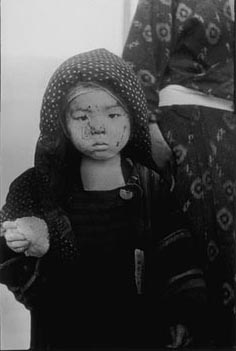
video includes original archival photographs of the horrific aftermath
in both cities. People were instantaneously turned into shadows, and those
several miles away were severely burned, blinded and made fatally ill.
I show you the human heart of darkness, because without knowing
the impact of our actions, the actual facts of our evil, if you will, we
cannot really consciously turn toward meaningful peace.
I consider it a sacrament to endure the pain of viewing these
images and a tribute to the victims. Even though the video images are mesmerizing in their horror,
I encourage you to especially listen to the music, since it is the
essential expression of the work. In
fact, the music could stand alone as a self-contained composition.
Much can be said around the attacks on Hiroshima and Nagasaki --
justifications, relativisations and the lack of 20/20 hindsight, but
they became the bitter vision of what humans are capable of, and in a
sense since that day, Hiroshima has never stopped happening.
The
last part of the work probably represents my most radical aesthetic
decision. I wanted to
contrast the old black and white photos that have a historical distance
with modern day pictures of Japanese children that are far more
immediate and present. The
modern pictures are banal in their ubiquitousness and content, but that
is exactly the point. We
sometimes distance ourselves from the horrors of the world by aestheticizing
them. It is the almost
cringing banality of the modern photos that forces us to consider humans
as real and not merely as historical, representational, aesthetic
artifacts. The horrors of
WWII are not merely those of another generation pictured in grainy black
and white photos. They are
our own horrors, and they will be forever.
We should never become accustomed to evil.
We should never let it hide behind ubiquitousness or banality.
Especially
significant to me are the images of the stopped pocket watch showing the
exact time of the explosion, 8:15 a.m., and the partially destroyed
bronze Buddha found among the rubble.
The symbolic ramifications boggle the mind. Light, which we
associate with goodness and truth, was used in this case to turn human
into shadows on concrete. And
the gentle wind was radioactive.
The
piece is in the ancient spirit of the lament--a woman weeping for the
dead, feeling appropriate feelings for the rest of the community,
helping us process our grief and thus move on to a deepened experience
of life. The trombone has
been used throughout Western musical history as the symbol of the
underworld, a tradition established by Monteverdi in Orfeo. It is also traditionally regarded as the noble mediator of
death and as the sounding blast of the last judgment. It is also associated with prophecy and revelation.
St. Hildegard von Bingen referred to herself as Posaune Gottes,
or Trombone of God. I
consider it a privilege to play this sacred instrument in this context.
Along
with the weeping of the trombone, my voice inarticulately keens a lament
called, “wie eine Posaune die sprach”, (“…as it were of a
trombone talking…”.) I
also sing the Latin text of Rachel’s Lament, and speak a few
lines of English text of my own. Of
the two melodic themes “…as it were of a trombone talking…” is
original, while the other, The
Lament of Rachel, is borrowed from the 12th century
Fleury (French) Medieval Drama, Slaughter of the Innocents from The
Play of Herod. The surround sound creates a world where perhaps we
can begin to truly empathize with the Japanese people.
The video is the altar or portal into which we gaze into
our/their hearts.
Composer
William Osborne, my husband, edited the video from hundreds of images I
collected. He edited the
music from over an hour of recordings I made of the original medieval
lament, “…as it were of a trombone talking…,” and my voice and
trombone improvisations. His
contribution was absolutely invaluable.
Though it was not clear at the conception of this work, he should
be listed as co-composer. We
often work so closely together that we can’t remember who had what
idea. This is our ideal and
our practice.
In
The Play of Herod, Rachel stands over and weeps for the murdered
children of Israel while her women friends attempt three times to
console her.
She
will have none of it. Rachel’s final words are:
«Anxiatus
est in me spiritus meus; in me turbatum est cor meum.»
“My
spirit is anxious within me; within me my heart is troubled.”
After
Hiroshima, surely we are all Rachel’s children.
Abbie
Conant
|