|
Video: Living In Two Worlds
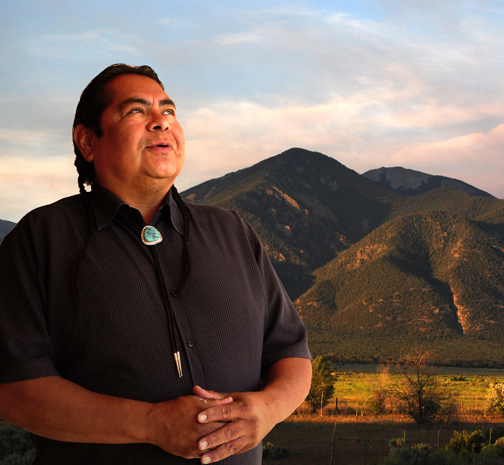
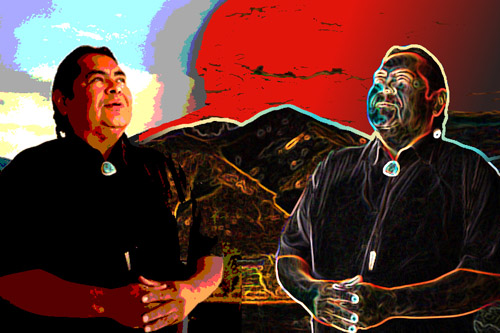
Patrick J. Romero speaks about the Taos Pueblo in the salon of William Osborne and Abbie Conant on January 9, 2011.
To go straight to the video and its index, scroll down.
Requires RealPlayer. Free download here.
Introduction
For
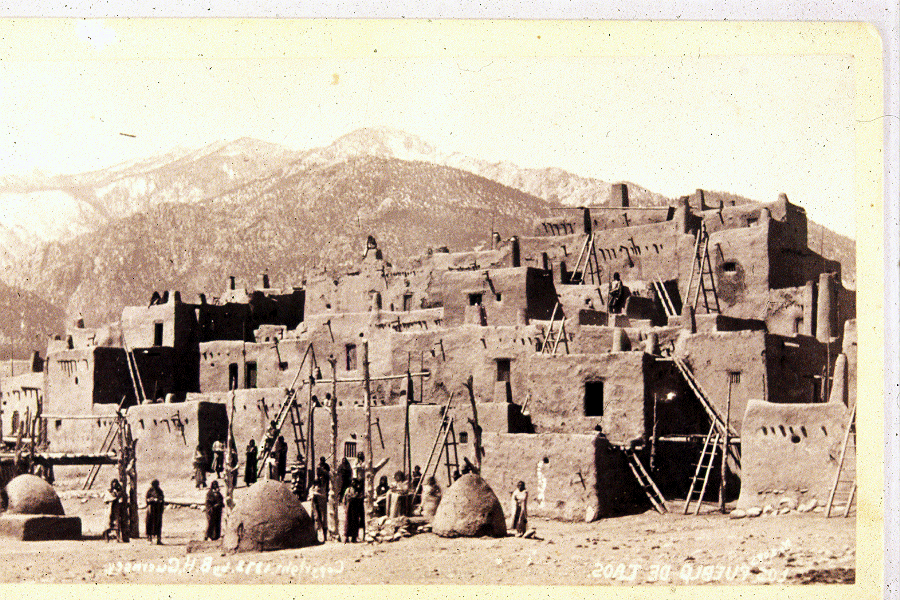
many, the Taos Pueblo remains a mystery even though the tribal members have
lived in close proximity to the surrounding cultures for hundreds of years.
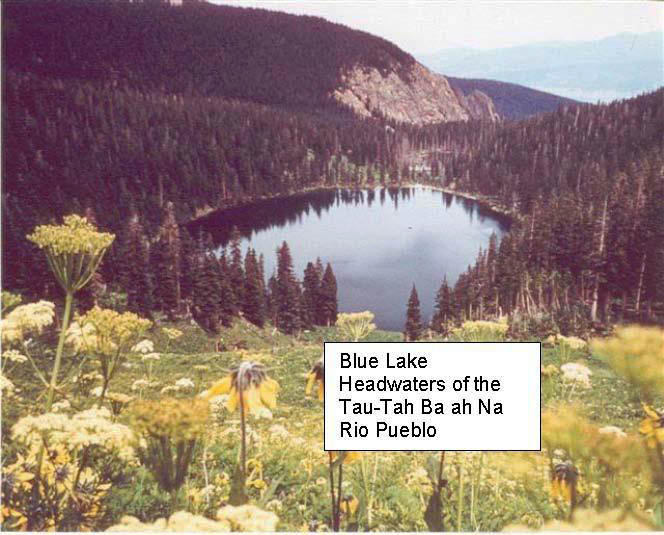
Outsiders sense the wisdom in the Puebloan way of living, but it remains
indecipherable and almost Delphic, something enigmatic and fathomless,
something shrouded in the beauty and gentleness of their natures. And
yet the Puebloans are obligated to live completely in the modern world, not
only sharing the same joys and frustrations of modern life as all of us, but
even serving as political, cultural, and educational leaders in our
Eurocentric community. How do they manage to bridge these two worlds?
How do they maintain their notable gentleness and often peaceful natures in
the harshness of the modern world? How and why do they maintain their
traditional way of life in the face of a surrounding, hegemonistic, and
overpowering Eurocentric society?
Taos Pueblo tribal member Patrick J. Romero addresses these questions and many more in the video below. I have included a hyper-linked index that will take you with a simple click to any of the 83 topics Mr. Romero addresses.
Patrick
represents in his person many characteristics of Taos Puebloan society.
He has lived most of his life on or near the
In this talk, he faces daunting challenges because almost any attempt to describe Puebloans, or Puebloan culture is by necessity reductive and essentializing. Cultures are living, constantly evolving, and infinitely complex. Attempts at description or explanation can turn the actual people and societies into mere stick figures, which something that Mr. Romero successfully avoids. He prefers to take a simple, non-academic, modest, and even humorous approach. We can learn a great deal by observing in his person an authentic Puebloan nature and personality.
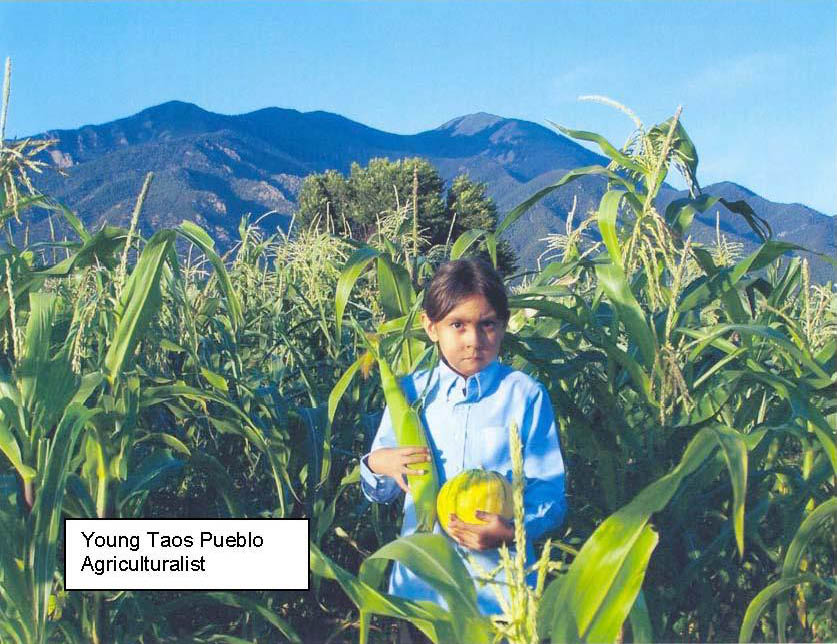
Every culture, for example, seems to create its own sense of time. Puebloans live by their own rhythms, and we can sense this as Patrick speaks. Those who have had the good fortune to observe Puebloan dance might already be familiar with this different world of time. Definite beginnings and endings for the events are seldom scheduled. The viewers simply wait until the dancers are ready, and the performers take their time with just about everything they do. In the eyes of the dominant culture, it might seem static and disorganized but it is not. The Puebloans simply have a different way of pacing and organizing what they do. Patrick expresses similar cultural values in his talk.
We might also remember that forms of linear, argumentative, analytical thought are something more specific to European culture. Puebloans seldom hammer out quickly marshaled points in an attempt to persuade. Numerous Native American authors illustrate that they can do that very well if needed, but that in general it isn’t to their taste. Patrick does not present himself as an authority, even if in many respects he is one. He does not pontificate or lecture, but speaks in a calm, dignified, humorous and respectful manner that allows us a glimpse into his world.
Many native cultures might even suggest that an overly analytical approach chops the world into pieces and destroys the beauty of its wholeness. Puebloans see the world as sacred, living, and always changing. To freeze and objectify it with clear cut definitions and analysis might in some cases even seem like a kind of foolishness to them. In this spirit, many members of the Taos Pueblo are even opposed to attempts to create a written form of their language. They feel that if their language were frozen into a written form it would lose its life and sacred power.
One of the most obvious examples of this reverence for spoken language is Patrick’s use of questions and answers. For many Puebloans, to plan in excessive detail what one is going to say, as if one’s thoughts were in a written or semi-written form, would objectify the listener, as if they had no thoughts of their own, as if the world were bound in one place and time. To lecture instead of interact and listen would almost be an act of disrespect, and even more, disharmony with the natural order of the world. And most interestingly, this is not a conscious philosophy, its just the way they were brought up. It reflects what they think of as good manners and kindness – something that doesn’t need to be described with ten dollar words, as Patrick puts it.
Mr. Romero also illustrates how Native Americans maintain a living culture that continues to evolve and grow, and that might even be moving toward a renaissance -- something long prophesied in their religion. And with no small amount of humor, he addresses what he calls the "John Wayne Syndrome" which expects Native Americans to hold only to stereo-typical clichés in their culture and life styles.
Finally, I should note that the only areas excluded in the discussions are the Taos Pueblo’s religious beliefs, which according to tradition must remain known only to members of the tribe. This is not aloofness or a meaningless desire to be separate since religious privacy maintains the vitality, power, and sanctity of their rituals which they use for the benefit of nature and all humans.
We can bring our own expectations to the Puebloans, but they are who they are. And that is the joy of it. It is not only from their words, but also from experiencing their way of being and thinking that we can learn many much needed lessons for our own Euro-centric culture. For those willing to learn, this video of Patrick J. Romero exemplifies the wisdom of the Puebloan way of being.
Requires RealPlayer. Free download here.
Topics - Tape One The video image looks best if maximized in size.
1. Introduction; locking himself out of his pickup. 0:00 2. The content of the talk 4:30 3. Why he was born in Santa Fe; the transport of native mothers to a hospital in Santa Fe; about addressing who we are as Taos Pueblo people 5:27 4. I am a teacher trained by life and my elders 7:06 5. Military service and time in Germany 9:24 6. About sharing knowledge about the Pueblo 10:30 7. Things I've done in my life; the branches of tribal government 11:30 8. The difficulties of representing the Taos Pueblo 12:54 9. The return of Blue Lake; our land and sacred places; our heaven 13:54 10. The land area size of the pueblo and the number of members 14:35 11. We believe we are put here for a reason; the meaning of homeland; the Red Willow People 15:49 12. The image of George Washington on Taos Mountain 16:41 13. The cattle guard side of our land; Indian horses; our tracts of land apart from the village and mountain 17:39 14. Working with young people; being Santa Claus 20:26 15. Taos Pueblo School 22:37 16. Memories of attending the Taos Pueblo Day School; suppression of the Tiwa language; now the language is encouraged 24:15 17. Santa Fe Indian School 26:37 18. Other Taos schools 27:17 19. Work with the school board; Pueblo students; Taos Puebloans as highly educated professionals 28:00 20. New challenges in education; technology makes students restless; videos about killing police officers 30:06 21. Hispanic enculturation and the loss of Puebloan identity 31:08 22. Efforts to keep the Tiwa language alive 34:09 23. Audience question: Can something be done by non-Puebloans to help preserve the language? 36:34 24. My work on the pueblo as a TLC teacher (Tradition, Language, Culture) 38:43 25. Teaching students the traditional significance of harvesting corn 39:56 26. More about Puebloans as educated professionals, physicians, lawyers, teachers 42:04 27. Tribal administration 43:24 28. The tribal buffalo herd 45:37
Topics - Tape Two The video image looks best if maximized in size.
1. More about the buffalo herd and other wildlife on the reservation 0:00 2. Using every part of harvested animals 1:02 3. Location of the buffalo herd and its care by the war chief staff 2:02 4. A story about harvesting a buffalo and the meaning of its life 2:49 5. A buffalo joke 3:50 6. A question from audience about a private buffalo herd on El Salto Road 4:10 7. Humorous comments about the slides shown; traveling by wagon and horse 4:34 8. The Turtle Dance 6:31 9. The quiet season, letting the main plaza (the mother) rest, massaging the plaza's back with dance. 7:53 10. The Buffalo Dance and winter dances sponsored by different kivas 8:10 11. Feast Day and foot races 9:05 12. Summer dances, corn dance, rabbit hunt 10:06 13. Taos Pueblo Pow-Wow, explanation that it is not traditional 10:59 14. San Geronimo Feast Day, foot races, the black-eyed people as sacred clowns 12:01 15. All Souls day, thanksgiving, story about Thanksgiving in Germany when he was a soldier 12:43 16. Christmas season 15:05 17. Matachines dance: a native vision of Montezuma that was later Hispanicized 15:47 18. Other Christmas dances: Deer Dance, procession of the Virgin Mary 17:23 19. Feasting 18:13 20. Comments about intermission, crowd control, jokes about suction cup arrows 18;50
Intermission
21. Pueblo Dress 19:44 22. My involvement in Peublo religious activities 20:16 23. Crossing between native and modern worlds is almost like being two people 21:16 24. School board work 21:39 25. Problems with obtaining community funding 22:08 26. The three cultural communities of Taos 23:01 27. The city and county lack of consultation with tribal government 24:26 28. Problems with state government concerning natives 25:17 29. Personal experiences with alcoholism 26:05 30. Problems with alcohol and drug abuse on the Pueblo 28:24 31. Pueblo programs for dealing with alcohol and drug abuse, intensive out-patient program 29:13 32. Ratio between male and female alcoholism 32:07 33. Invitations to private homes on feast days 33:21 34. Problems caused by the short terms of tribal officials 34:27 35. Relations between the Taos and Picuris Pueblos (mostly humor) 35:28 36. Our system of government was imposed by the Spaniards and should be changed 35:57 37. A tribal member in the audience concurs (Jonathan) 37:54 38. Jonathan discusses problems with obtaining care for his elderly father 38:24 39. Audience members asks what it would take to improve tribal government, Jonathan responds 39:44 40. Why the Pueblo maintains a system of government imposed by Spanish rule 40:57 41. Why are there no women on the tribal council? 42:29 42. How the Navajos reformed their government 44:20 43. Audience member asks if newly emphasized elements of Hopi matriarchy might eventually influence the Taos Pueblo 45:26 44. The seven teachings of the First Nations People 46:14 45. Audience question: How does the Pueblo feel about you giving talks like this one? 48:58 46. African-Americans as an example of Puebloan sensibilities toward other peoples 49:45 47. Audience question: Would an outside aid group such as a possible "Friends of Taos Pueblo" be of help? 51:42 48. Audience member comments that such a group could serve as advocates with the city government 53:12 49. Comments about this being the first time he has given such a talk 54:29 50. Comments about his radio show "Moccasin Wire" 55:09 51. A media workshop at the Taos Pueblo 56:14 52. Currently unemployed and loving it 57:07 53. The Catholic Church at the Pueblo 57:52 54. The season when tourists are not allowed on the Pueblo 58:12 55. The Red Willow Farmers Market 58:48
|