Music for the End of Time
(For trombone, video, and quadraphonic surround sound.)
Table of Contents
1. General Description
2. PDF Score
3. Downloadable practice CD
4. An excerpt from Movement III, The Four Horsemen (Stereo)
5. The Complete Video (stereo reduction from the surround sound)
6. Six video clips showing the score
7. A complete video score of the work showing the music notation
8. Program Notes
9. Commentary

1. General Description
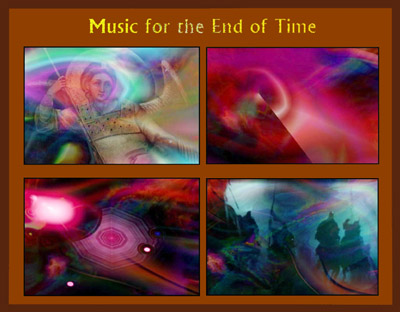 “Music for the End of
Time” is a 52-minute work for trombone, video and quadraphonic electronics
based on the Book of Revelation. Premiere: Montreal, McGill University, March 1998. The
version with optional video was premiered in our Taos studio in September, 2007.
Abbie
Conant, trombone; Norbert Bach, digital stills; William Osborne, music and
video. The work is in
in six movements:
“Music for the End of
Time” is a 52-minute work for trombone, video and quadraphonic electronics
based on the Book of Revelation. Premiere: Montreal, McGill University, March 1998. The
version with optional video was premiered in our Taos studio in September, 2007.
Abbie
Conant, trombone; Norbert Bach, digital stills; William Osborne, music and
video. The work is in
in six movements:
I. A Door Was Opened In Heaven
II. The Sea of Glass
III. The Four Horsemen
IV. As It Were of a Trumpet Talking
V. The White Beast
VI. A Woman Clothed With the Sun
2. PDF Score
To download the PDF score click here. (The score is pixelated on screen, but prints beautifully.)
3. Performance Materials
To obtain the performance materials contact William Osborne at:
4. An excerpt from Movement III, The Four Horsemen (Stereo)
(Good headphones strongly recommended.)
5. The Complete Video In A Stereo Reduction
(Good headphones strongly recommended.)
6. A video of six short clips with the score
(Good headphones strongly recommended.)
7. A Score Video of the complete work showing the music notation
(Good headphones strongly recommended.)
8. Program Notes
 Music
for the End of Time
was part of Abbie Conant’s
project, entitled "The Wired Goddess and her Trombone.” Her goal was to
work with composers to create compositions for computer and trombone
based on the theme of the Goddess. She
premiered 14 works during this project.
Music
for the End of Time
was part of Abbie Conant’s
project, entitled "The Wired Goddess and her Trombone.” Her goal was to
work with composers to create compositions for computer and trombone
based on the theme of the Goddess. She
premiered 14 works during this project.
The score for
Music
for the End of Time was completed in 1998 and premiered at McGill
University the same year. The
optional video version was
completed in 2007 and premiered in Taos, NM.
This is one of several large scale, music theater or multi-media
works William has completed for Abbie.
Our goal has been to explore new dimensions of performance art
and create substantial, meaningful works for the trombone.
These are the movements and the verses from the Book of Revelation they allude to:
I. A Door Was Opened in Heaven,
After this I looked, and, behold, a door was opened in heaven: and the first voice which I heard was as it were of a trumpet talking with me; which said, Come up hither, and I will shew thee things which must be hereafter. (Rev. 4:1.)
II. The Sea of Glass
And before the throne was a sea of glass like unto crystal: and in the midst of the throne, and round about the throne, were four beasts full of eyes before and behind. (Rev. 4.6)
III. The Four Horsemen
And thus I saw the horses in the vision, and them that sat on them, having breastplates of fire, and of jacinth, and brimstone: and the heads of the horses were as the heads of lions; and out of their mouths issued fire and smoke and brimstone. (Rev. 9:17)
IV. As It Were A Trumpet Talking
After this I looked, and, behold, a door was opened in heaven: and the first voice which I heard was as it were of a trumpet talking with me; which said, Come up hither, and I will shew thee things which must be hereafter. (Rev. 4:1.)
V. The White Beast
And I looked, and behold a pale horse: and his name that sat on him was Death, and Hell followed with him. And power was given unto them over the fourth part of the earth, to kill with sword, and hunger, and with death, and with the beasts of the earth. (Rev. 6:8)
VI. A Woman Clothed With the Sun
And there appeared a great wonder in heaven; a woman clothed with the sun, and the moon under her feet, and upon her head a crown of twelve stars. (Rev. 12:1)
9. Commentary
Music for the End of Time explores social, psychological, and philosophical themes of eschatology. These include:
• Numinous Experience: We were influenced by the early 20th
century philosopher and theologian, Rudolf Otto, who described numinous
experience as a universal aspect of religious experience in all cultures.
• Imagistic Meaning: We explore imagistic and musical meaning
as a numinous approach to the unknowable, exploring how metaphors and symbols
transcend the limitations of rationality and linguistic constructs.
• Transcendental Imagery: Transcendental experience is
depicted as similar to hallucination, a kaleidoscope of uncontrollable
numinous symbols the mind cannot fully grasp.
• Philosophical Perspectives: We explore the interruption of
familiar states of being and the division of the world into rational and
irrational realms.
• Apocalyptic Themes: We explore the apocalyptic as a search for transcendence and critique its often patriarchal and militaristic nature that follows a pattern of revelation, ecstasy, destruction, and remorse.
• Consciousness and Rationality: We specifically explore the
horrors of the 20th century, the collapse of culture, and the dangers of
reverting to non-rational ideals as the basis of social organization.
• Romantic Era Concepts: We explore the Romantic pathos of the artist-prophet projected into the 20th century and how it created reckless abandon that led to destruction, desolation, and lamentation.
• Language and Ineffability: We explore the metaphor of the eternal feminine as a spiritual response to the 20th century’s horrors that claimed 80 million lives.
• The Culture of New Mexico: We were influenced by the
cultural atmosphere of Northern New Mexico where Hispanic farmers in isolated
villages of the Sangre de Christo Mountains still embody with great humility
long forgotten quasi-medieval concepts of spiritual transcendence. Their
symbols, mythologies, and spiritual perspectives are little understood by the
modern world, but often greatly admired for their cultural beauty and unique
perspectives.
| Taos Studio | Photos | Poetry | Trombone Class | Miscellaneous |